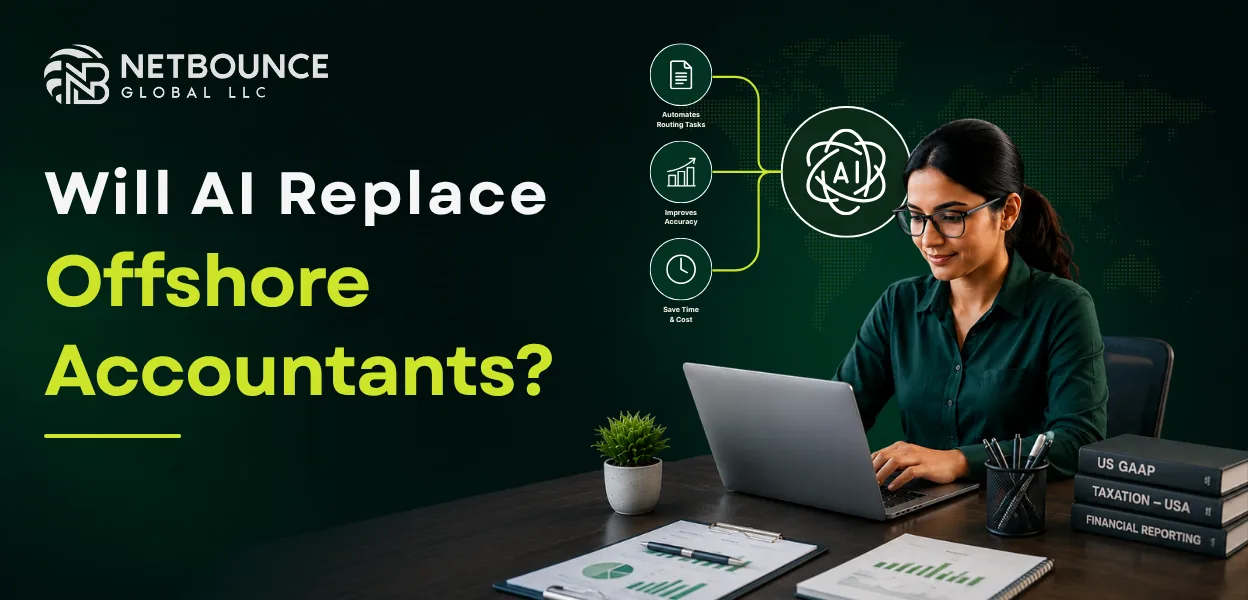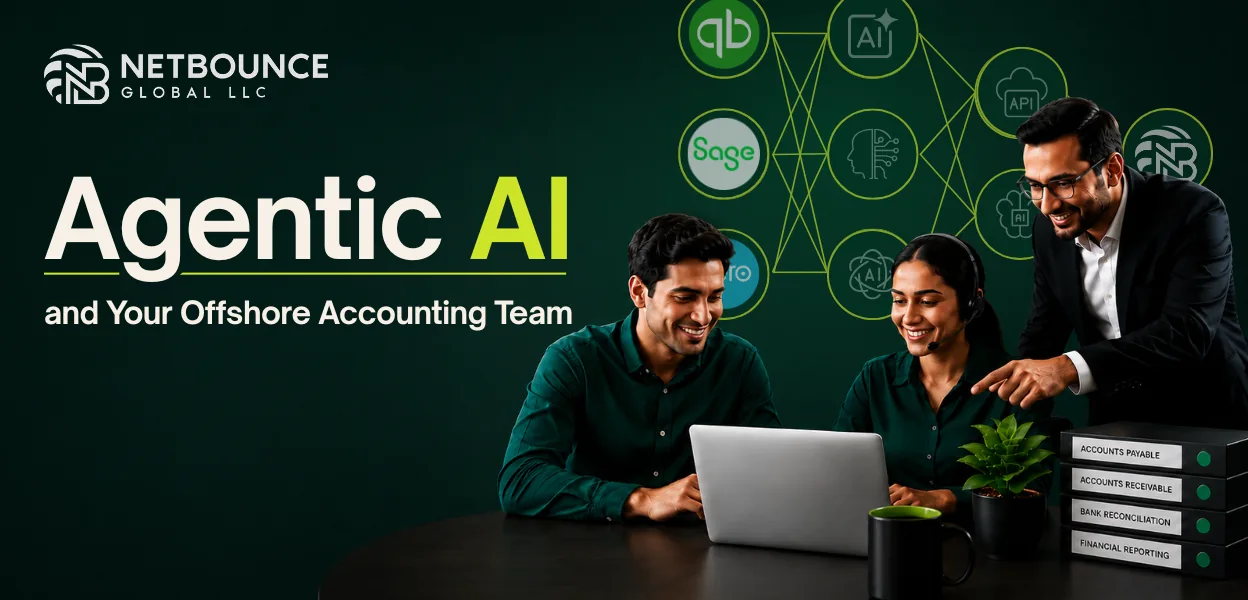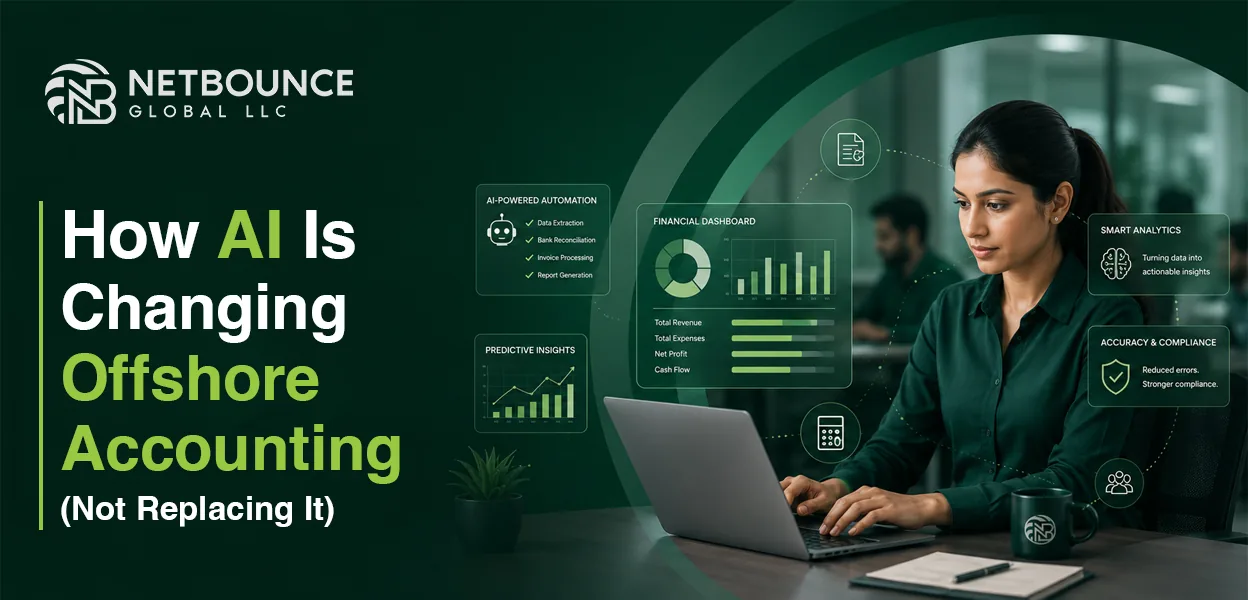
If AI can read a receipt, categorize a transaction, and draft a tax return, why would a firm still pay for an offshore accounting team?
It is a fair question, and the honest answer is this: AI is changing what offshore accounting teams do, not whether firms need them. The tools have absorbed the repetitive first pass. The judgment, the review, and the client relationship still sit with a trained professional.
Here is what AI handles today, what still needs a person, and how the two fit together role by role.
What Is Offshore Accounting, and What's Actually Changing?
Offshore accounting is the practice of having qualified accounting professionals based outside the US work as a direct extension of a firm's team. Unlike a project-based vendor, a dedicated offshore professional works inside your systems, follows your processes, and handles the same clients month after month.
What is changing is not the need for that person. It is the toolkit they work with, and how much routine work reaches their desk.
Where AI Is Actually Doing the Work Today
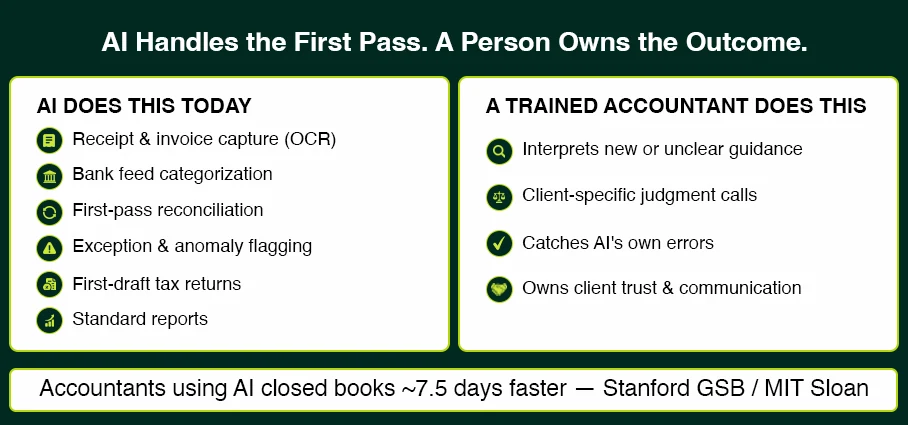
Set aside the 2030 predictions. Here is what AI reliably handles today:
- Receipt and invoice data capture through OCR
- Bank feed categorization and first-pass reconciliation
- Anomaly and exception flagging across large transaction volumes
- First-draft tax preparation from source documents
- Standard report generation and routine client updates
Notice the pattern. Every item is structured and repetitive. That is the layer where automation in accounting works well, and the gains are measurable.
As that structured layer gets absorbed, it stops being the thing clients are paying for. We follow that shift through to its conclusion in bookkeeping is no longer the product, decision-making is.
Research from Stanford Graduate School of Business and MIT Sloan, drawing on 277 accountants and transaction data from 79 firms, found that accountants using AI closed monthly books about 7.5 days faster and supported more clients per week, with quality improving rather than slipping. The study also notes these tools sit mostly in bookkeeping, while audit, tax strategy, and valuation remain largely untouched.
What Still Needs a Trained Person
The list of what AI does not handle reliably is shorter, but carries far more risk:
- Interpreting new or ambiguous guidance
- Entity-specific and client-specific judgment calls
- Catching its own mistakes, such as misread OCR or mis-categorized transactions
- Client trust, context, and communication
The same research surfaced a finding that should reshape how firms think about this. AI delivered its biggest gains for experienced accountants, who treated it as a collaborator and stepped in when the system's confidence dropped. Less experienced staff more often took output at face value, even when the tool flagged uncertainty, and saw smaller gains.
That reframes the debate. The question was never AI or people. It is which people. Skill level, not the software, decides whether an AI-assisted workflow produces clean books or errors that surface later.
The Integrated Workforce Model
The integrated workforce model is simple to state. AI handles the first-pass, repetitive processing. A dedicated offshore professional reviews that output, corrects it, and owns every judgment call. That professional extends your onshore team rather than replacing the software or the CPA who signs off.
This is not a fringe setup. Offshore accounting for CPA firms increasingly means a blended mix of onshore staff, offshore professionals, and AI-assisted tooling, an approach we broke down in our guide to the 60/20/20 workforce model. It is also the daily reality for NetBounce Global clients, whose professionals are matched to a firm's software and the AI tools on top of it.
Role by Role: How AI Changes 4 Offshore Positions
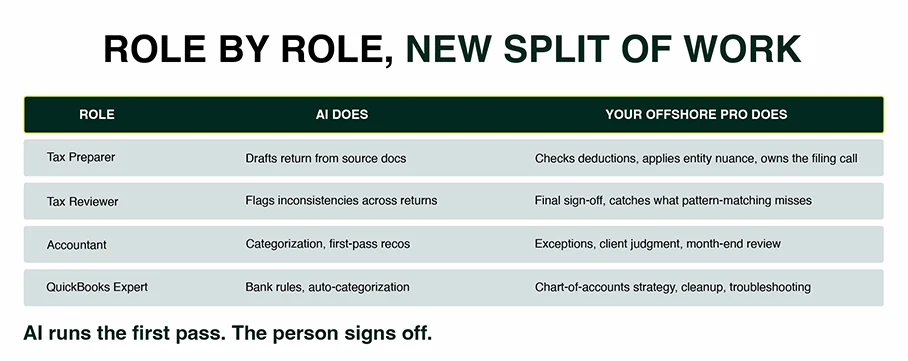
The shift differs by seat, but the pattern holds: AI handles the first pass, the person owns the outcome.
Tax Preparer
AI drafts a first-pass return directly from source documents. The tax preparer checks deductions and credits, applies entity-specific nuance the model misses, and owns the final filing call.
Tax Reviewer
AI flags inconsistencies across a batch of returns far faster than manual review. The tax reviewer still performs final sign-off and catches what pattern-matching cannot.
Accountant
AI speeds up categorization and first-pass reconciliation. The accountant manages exceptions, applies client-specific judgment, and owns month-end review before anything reaches a partner.
QuickBooks Expert
AI assists with bank rules and auto-categorization. The QuickBooks expert still owns chart-of-accounts strategy, cleanup, and troubleshooting problems automation cannot diagnose.
What This Means for Your Firm
If you are planning capacity for next busy season:
- Stop framing it as AI versus offshore. The firms pulling ahead combine both.
- Screen offshore candidates for AI-assisted platform experience, not just data-entry speed.
- Put your review protocol in writing: who checks AI output, at which step.
- Treat offshore staff augmentation for accounting firms as a flexible layer that scales with workload, not a fixed headcount bet.
- Fold AI tool changes into your offshore team's training cadence, as you would in-house.
- Accounting staff augmentation works best when the person already knows your stack.
How NetBounce Global Helps
The hard part is not the software. It is finding people who can work alongside it and catch what it misses.
NetBounce Global provides dedicated offshore accounting staff to CPA and accounting firms, bookkeeping practices, small and mid-size businesses, and high-growth startups, screened for exactly that:
- Matched to your stack and your AI tools, from QuickBooks and Xero to Lacerte and Drake.
- Dedicated to one firm, so they learn your review protocol instead of guessing at it.
- Vetted profiles in 48 hours, working in your files in about four days.
- 60 to 70% less than an equivalent US hire, with no recruitment overhead.
- ISO 27001 certified, with VPN-only access and MFA.
- Scale up or down on 30 days' notice as workload shifts.
The Bottom Line
AI has changed offshore accounting. It absorbed the structured, repetitive layer and handed those hours back to the people doing the work. It did not remove the need for a professional who reviews the output and stands behind the numbers.
The firms getting the most from AI paired it with the right people, rather than assuming software could go it alone.
Frequently Asked Questions
Offshore accounting means having qualified professionals based outside the US work as a direct extension of your team, using your software and processes. Unlike a project-based vendor, a dedicated offshore professional handles the same clients consistently over time.
No. Research shows AI automates repetitive processing but still depends on experienced professionals to review output, catch errors, and make judgment calls. AI changes what offshore accountants spend their day on, not whether firms need them.
Receipt and invoice capture, bank feed categorization, first-pass reconciliation, exception flagging, first-draft tax preparation, and standard reporting. These tools are concentrated in bookkeeping, while audit, tax strategy, and valuation remain largely manual.
AI runs the first pass on repetitive processing. A dedicated offshore professional reviews the output, corrects errors, and owns every judgment call, with a written protocol defining who checks what before work reaches a partner.
A dedicated offshore professional typically costs 60 to 70% less than an equivalent US hire, all-in. The exact figure depends on the role, experience level, and scope of work, and there is no recruitment overhead. We break the numbers down in our full cost comparison.
With a properly certified provider, yes. Look for ISO 27001 certification, VPN-only access with no direct connection to client systems, MFA on every platform, individual NDAs signed before anyone touches data, and no client files stored on local machines. This matters more as AI tools handle client data.