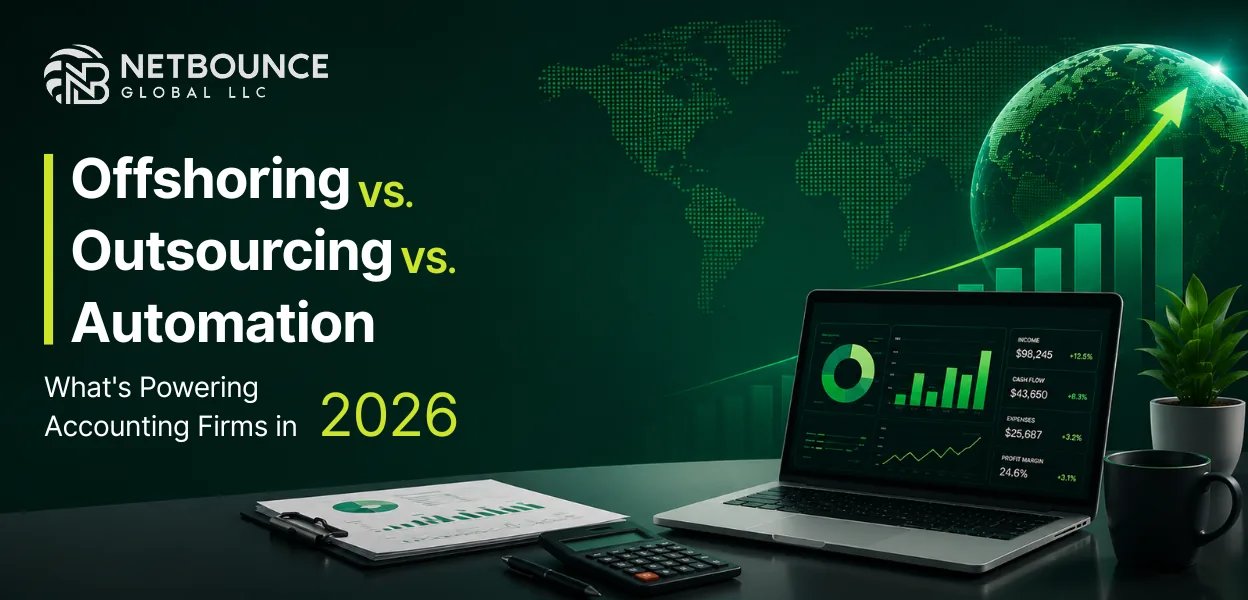
Accounting firms across the U.S. are standing at a crossroads in 2026. Talent shortages, rising labor costs, and client demands for real-time insights are forcing firms to rethink how they operate. And in every conversation we have with firm owners, three terms keep getting used interchangeably — offshoring, outsourcing, and automation.
They're not the same. They solve different problems, they cost different amounts, and they have wildly different impacts on how your firm runs. Treating them as synonyms is why so many firm owners end up making the wrong call for their situation.
Let's break down what each one actually means — and more importantly, when to reach for which.
Outsourcing: Delegating the Task, Not the Team
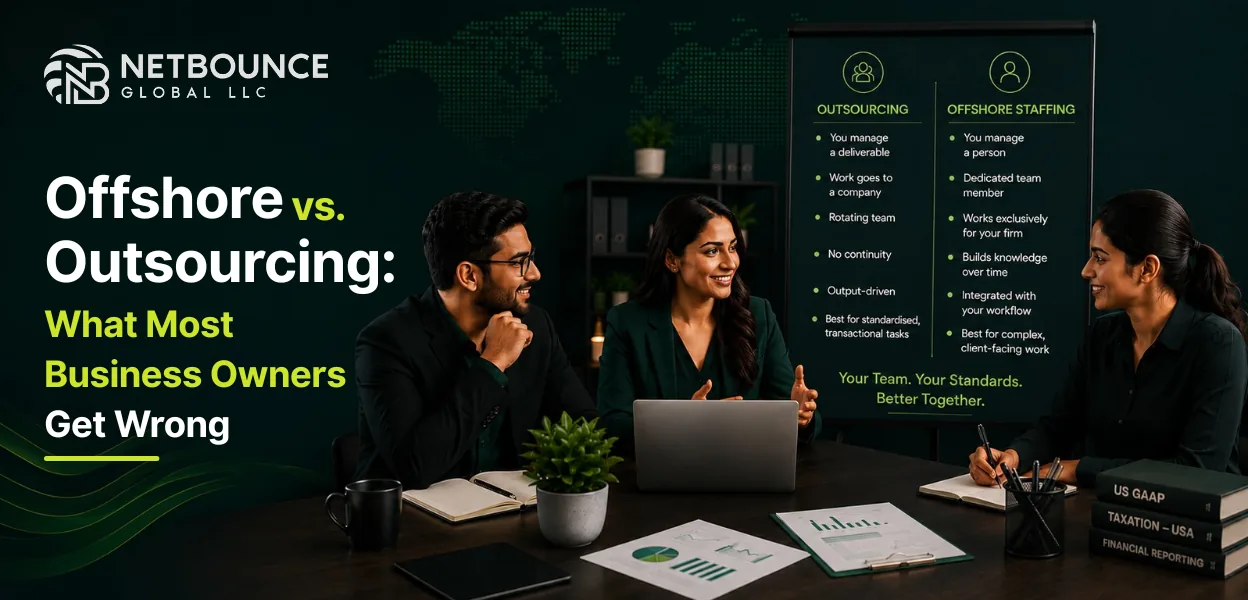
Outsourcing means hiring an external service provider to complete specific functions — usually tax preparation or bookkeeping — on a per-project or per-return basis. It's a transactional model. You send work out, it comes back, you pay for outputs.
What outsourcing is good at:
- Immediate capacity relief without hiring full-time staff
- Access to specialized expertise you don't use often (e.g. multistate tax, complex trust returns)
- Zero training or management overhead — you're paying for the deliverable, not managing a person
- Scaling up or down quickly based on workload
Where outsourcing falls short:
- Limited control over process and timelines. The provider runs on their schedule, not yours.
- Inconsistent quality. You might work with a different preparer every engagement.
- Knowledge doesn't stay inside your firm. Each project ends, takeaways walk out with the provider.
- Difficult to maintain client relationships when the work is done by strangers.
- Per-return or per-hour costs add up quickly at scale.
When outsourcing makes sense: Specialized, occasional work that doesn't justify a dedicated hire. One-off cleanup projects. Overflow tax returns during the worst weeks of busy season when you just need bodies, not team members.
Offshoring: Building a Dedicated Team, Abroad
Offshoring is different. You're not buying deliverables. You're hiring team members. A dedicated offshore bookkeeper, accountant, or tax preparer who works your hours, uses your software, knows your clients, and reports into your firm like any other team member — who happens to be based in India (or the Philippines, or elsewhere).
What offshoring is good at:
- Structural capacity, not transactional. You get a person, not a pile of deliverables.
- Consistency. The same person works your clients month after month, learns your workflows, builds the relationships.
- Cost efficiency at 50–70% below domestic rates — without the inconsistency of outsourcing.
- Knowledge stays inside your firm. Documentation builds. Process matures.
- Scales with your firm. Add one specialist this year, another next year, as capacity allows.
Where offshoring requires more thought:
- It's a hire, not a transaction. You need to onboard, manage, and build a relationship — just like you would with any team member.
- Requires deliberate overlap hours. If your specialist is in India and you're in New York, you need to define when you collaborate.
- Results show up in 60-90 days, not overnight. Training and ramp-up still applies, even with pre-vetted specialists.
When offshoring makes sense: When you need ongoing, recurring capacity. When you want to build something structurally rather than patch a hole. When you want the firm to have leverage — meaning the output of senior people multiplies because execution is handled.
Automation: Letting Software Do What Software Does Well
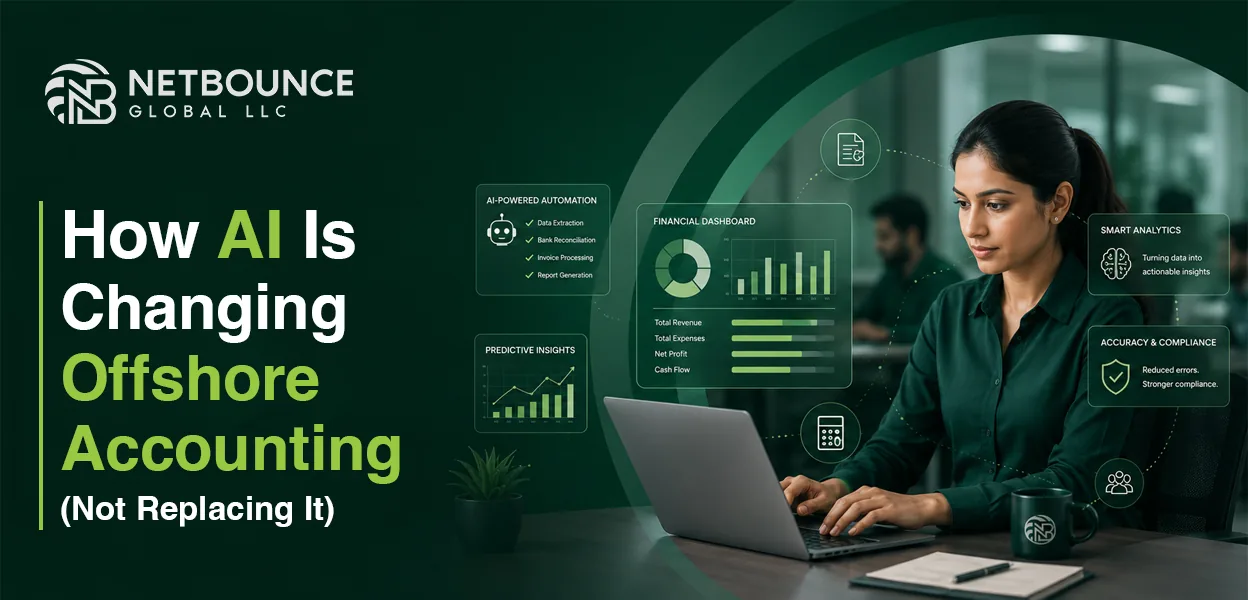
Automation is the third leg of the stool. And in 2026, it's the leg that's growing fastest. Modern accounting automation means software and AI that handles specific, rule-based tasks without human touch — data entry from receipts, bank feed categorization, client reminder emails, document collection workflows, standardized report generation, even first-pass anomaly detection on the books.
In 2026, firms are using tools like:
- Data capture and categorization: Dext, Hubdoc, AutoEntry, Bill.com's AI-assisted categorization
- Close and review: Karbon, FloQast, Botkeeper
- Client communication: Keeper, Content Snare, Liscio
- Anomaly detection and assurance: Trullion, MindBridge, specialized AI layers in QuickBooks and Xero
What automation is good at:
- Repetitive, rule-based work that takes humans time but requires no judgment
- Data entry, categorization, reconciliation matching, standard reporting
- Scaling volume without scaling cost
- Catching errors that humans miss when fatigued
Where automation falls short:
- Anything requiring judgment, client relationships, or ambiguous decision-making
- Tax strategy, advisory work, tricky reconciliations with unclear categorizations
- Setup and integration cost — automation doesn't run itself, someone has to configure and maintain it
- Client explanations. AI can detect anomalies. It can't sit with a client and walk them through why their margins changed.
When automation makes sense: Always, but for specific layers. Every firm should be automating data entry and standard reconciliations by now. The question isn't whether to automate — it's which tasks to automate, and who runs the automation.
When to Use Each, Practically
Here's a framework that fits most firm situations we see:
Concretely:
- Multistate SALT consulting for one client that has operations in 14 states? Outsource to a specialist firm.
- Monthly bookkeeping, close, and management reports for your recurring client book? Offshore, dedicated specialist.
- Categorizing 400 bank feed transactions every month? Automate with AI-assisted categorization, reviewed by the offshore specialist.
- Client advisory meeting on tax strategy and year-end planning? Keep with your domestic partner or senior.
Most firms we work with use all three, deliberately layered. That's the point. They're not alternatives. They're complementary.
The Hybrid Model — Why the Best Firms Run All Three
The firms that are growing fastest in 2026 aren't the ones that picked one lane and optimized it. They're the ones that layered all three into a coherent operating model.
It looks something like this in practice. A 15-person firm keeps 8 U.S.-based partners and managers focused on advisory, client relationships, and review. Three dedicated offshore specialists handle the recurring bookkeeping, monthly close, and tax prep execution. Automation tools — Bill.com, Dext, Karbon — handle the repetitive data entry and workflow layer underneath the offshore specialists. And for occasional specialized work, they outsource to boutique providers.
The result is a firm with margins that are 15-25 points higher than the industry average. Where partners spend their time on client work instead of tactical execution. Where the firm grows without hiring at the same pace as revenue.
That's what a mature hybrid model looks like. Not magic. Just deliberate layering.
The AI Shift in 2026 — And What It Means for the Model
Automation in accounting has changed significantly over the last 18 months. The arrival of genuinely useful AI tooling — not the hype, the actual workable features — has changed what's possible.
In 2026, AI layers are now reliably doing first-pass categorization, flagging anomalies, drafting client emails, summarizing bank activity, even generating first-draft reports from clean data. These are real productivity gains. They're not going away.
But here's what many firms are getting wrong about the AI shift. They're treating it as a replacement for people rather than a multiplier. AI doesn't replace bookkeepers. It makes bookkeepers dramatically more productive. A specialist who used to handle 5 client books per month can now handle 8 or 9 — but only if someone competent is running the AI layer, catching its mistakes, and handling the judgment calls AI still can't make.
That "someone competent" is typically where offshoring fits in beautifully in 2026. A dedicated offshore specialist at 40% of domestic cost, running an AI-augmented stack, delivering output that would have required two domestic hires five years ago. That's the compounding. The automation doesn't replace the human. It makes the human's output worth substantially more.
Firms that try to use AI alone — skipping the offshoring layer — find out quickly that AI needs a human operator. Firms that use offshoring alone, without investing in automation, find out their specialists are doing too much low-value data entry. The firms that layer them together are the ones pulling ahead.
The Real Question Isn't "Which One"
The outdated question was: should my firm offshore, outsource, or automate?
The current question is: what's the right layering of all three for my firm's specific structure and client mix?
If you're still treating them as alternatives, you're leaving margin and capacity on the table. The hybrid model isn't a trend. It's what the best-run firms in 2026 actually look like under the hood.
Common Questions About the Three-Way Choice
AI needs a human operator. Someone has to configure the rules, review exceptions, catch categorization errors, handle the judgment calls the AI flags, and maintain the automation over time. The offshore specialist is that human — and they cost 40% of a domestic equivalent while running the same AI-augmented stack. The combination is what makes the model work.
You can, but you'll pay for it in inconsistency and client relationships. Outsourced work is transactional — you hand off a project, you get back an output, the knowledge doesn't stay. For recurring client work that benefits from continuity, offshoring with a dedicated specialist wins on both quality and cost over time.
A simple test — is your team manually entering transaction data, manually chasing clients for documents, or manually generating the same reports every month? If yes, you have automation headroom. The fastest wins usually come from Dext or Hubdoc for document capture, Bill.com for AP, and Karbon or Jetpack Workflow for internal workflow automation.
Slightly. It's a hire, so there's onboarding. But the activation is quick — with NetBounce, you're reviewing vetted profiles in 48 hours and starting in 4 days. After the first few weeks, your specialist is integrated and the ongoing management looks similar to any internal team member.
For recurring work, offshoring at scale is usually the most cost-effective. Automation is near-zero marginal cost but has a ceiling on what it can handle. Outsourcing scales worst on price because you're paying per-output margin to the provider. Most firms we work with end up with most of their recurring labor dollars going to offshoring, a smaller chunk to automation tooling, and occasional outsourcing for specialized engagements.