Ten years ago, a client paid you to make the books correct. That was the deliverable. Getting a clean trial balance out of a shoebox of receipts was skilled work. It took real hours, and it was worth real money.
Today a client assumes the books are correct. Clean books are not the product anymore. They are the entry ticket.
What clients actually pay for now is the sentence that comes after the numbers. Should I hire in Q3 or wait? Can I afford this lease? Which of my five service lines is quietly losing money? That sentence is the product. The ledger is just the raw material it is made from.
Most firm owners already know this. The problem is that you cannot sell decisions when your best people are buried in categorization. The advisory conversation you keep meaning to have gets pushed to next month, every month, because your accountant is still reconciling.
This post is about the mechanical fix for that, and about what the work actually looks like on the other side.
What Actually Changed
Compliance work did not become less important. It became less scarce.
Bank feeds killed manual data entry. Rules engines learned to categorize repeat transactions without being asked twice. AI now handles a credible first pass at coding, matching, and flagging anomalies, and it does it overnight. The structured, repetitive layer of bookkeeping has been steadily automated. As we have written before, AI has changed offshore accounting without replacing the people who own the outcome.
When something stops being scarce, its price falls. That is not a prediction. It is just what happened to compliance work over the last decade. Clients who used to accept a monthly bookkeeping fee without comment now ask what else they are getting for it.
What they want instead is the “so what.” Cash flow guidance. A forecast they can plan hiring around. A read on which parts of the business are working. The profession has a name for this bundle, which is client advisory services, usually shortened to CAS. The appeal is straightforward. Advisory work prices on the value of the decision rather than the hours of the task, so it does not get squeezed the way compliance fees do.
The catch is that CAS is not a product you can buy and resell. It is your senior people’s judgment, sold by the hour or by the engagement. Which means the only way to sell more of it is to free more of their hours.
The Advisory Ceiling Is Capacity, Not Ambition
Almost every firm we talk to wants to move up-market. Very few of them are short on ambition. They are short on hours.
The specific failure is a seniority mismatch. Your Accountants and your Accounting Managers, the people you hired for judgment, are spending their week on Bookkeeper-level work. Reconciliations. Chasing missing receipts. Cleaning up a client’s coding. Work that has to happen, but not work that requires the person doing it to hold a degree and eight years of experience.
That is margin sitting on the floor. When a $95,000 accountant spends 40% of their time on $28,000 work, you are not just overpaying for those hours. You are also not billing the advisory hours that person could have delivered instead. It shows up in your revenue per employee long before it shows up in a conversation about strategy.
We have written the full capacity math elsewhere, including what a freed partner hour is actually worth at advisory rates, in our piece on how offshore staffing enables the advisory shift. The short version is that the arithmetic works, and it works at a scale most partners underestimate.
What that piece does not cover, and what this one is about, is the harder question underneath it. Once the hours are free, what exactly do you sell with them, and how do you decide which work goes where?
The Unlock: Move Routine Work Down, Move Your People Up
There are three obvious ways to solve a capacity problem, and two of them are bad.
You can hire more senior onshore staff, which is slow, expensive, and does not fix the underlying mismatch. You can let people go and absorb the work, which is how firms shrink. Or you can move the routine, high-volume work down a level and let your existing team climb into the work you actually want to sell.
The third one is the whole play. You are not replacing anyone. You are changing who does what.
In practice that means placing a dedicated offshore bookkeeper on the transactional layer, and moving your onshore accountants and accounting managers up into review, client conversation, and advisory delivery. Same headcount on your side. Different distribution of judgment.
This is accounting staff augmentation, and the distinction in that phrase matters. You are adding capacity to your team, under your direction, working in your files and your review process. You are not handing a client relationship to a vendor and hoping it comes back intact. The person is yours to manage, and the client stays yours.
What Is Offshore Accounting, Exactly?
Offshore accounting is when a US firm hires accounting professionals based in another country to work as part of its own team, rather than employing them locally. The person works your hours, in your software, on your clients, and reports to you. The firm handles their payroll, HR, and compliance in their home country, so you get the team member without the employment overhead.
The distinction that trips people up is offshore versus outsourced, and it is worth being precise about because they are not the same arrangement.
Outsourcing means you hand a process to a vendor. They decide who does it, how, and when. You get a deliverable back and you do not see inside the box. The work may be done by a different person each month.
Offshore staffing means you get a specific, named person embedded in your team. You interview them. You assign their work. You review their output. They join your standups. The only thing that is different from a local hire is where they sit and who runs their payroll. We covered the full offshore versus outsourcing distinction separately if you want the longer version.
At NetBounce Global specifically, that means three things. Professionals matched to your software stack rather than assigned at random. Dedicated to one firm rather than shared across several. And working through VPN-only access with MFA in an ISO 27001 certified environment.
What the Shift Looks Like in Practice
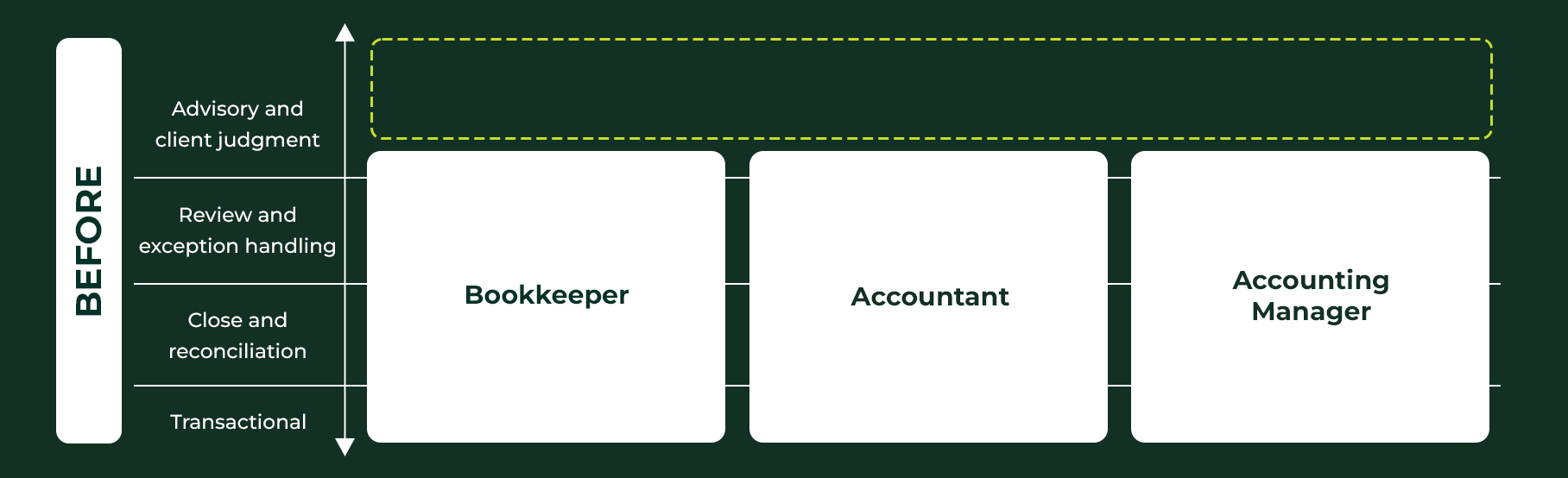
Before the shift, most firms look the same. Everyone does compliance. Partners review compliance. Advisory happens whenever someone finds a gap in the calendar, which is to say rarely, and usually in a hurry.
After the shift, the org chart splits along a different line. The transactional close belongs to the offshore team: coding, bank and credit card reconciliations, AP and AR upkeep, prepaid and accrual schedules, the first-pass workpapers. Your onshore team owns review, exception handling, and the client relationship.
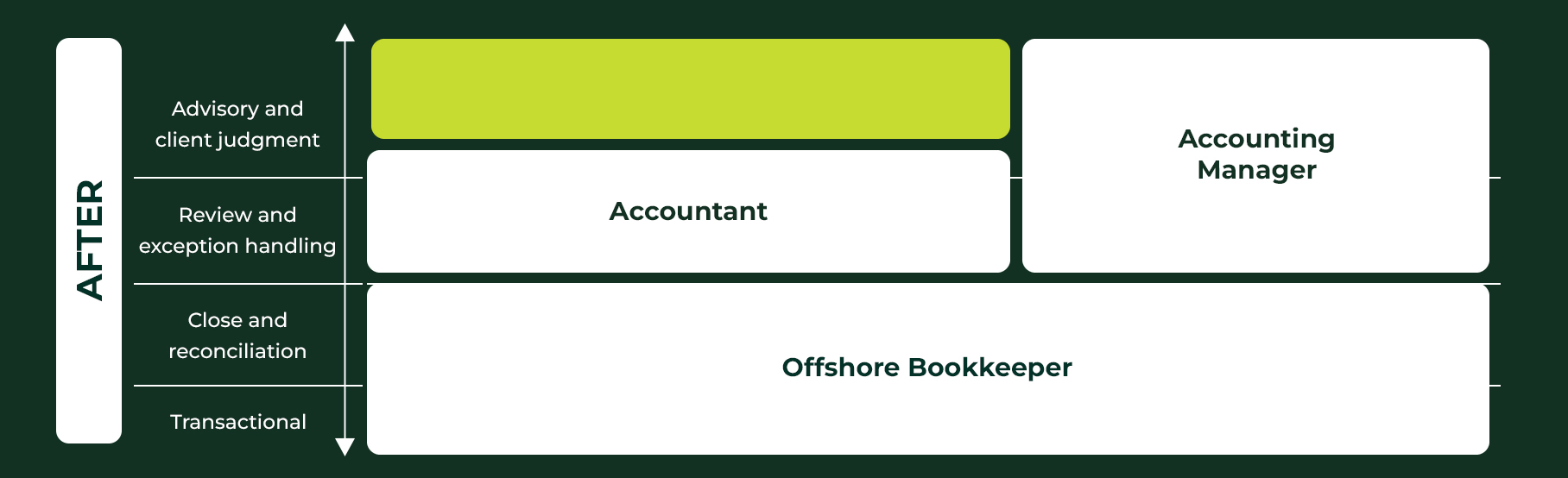
Then the interesting part. The hours that come back do not go into more compliance work. They go into work you could not previously staff:
- Cash flow forecasting. A rolling 13-week view a client can actually plan around, updated monthly rather than built once and abandoned.
- Scenario planning. What happens to runway if we hire two people in Q3? What happens if our largest client leaves? Questions like these need someone to sit with the numbers and think.
- KPI dashboards. Three to five metrics that matter for that specific business, tracked consistently, rather than a generic P&L emailed on the 15th.
- Monthly business reviews. A standing conversation about what the numbers mean, which is the single most effective retention mechanism in a professional services firm.
Notice what all four have in common. None of them can be automated, because none of them is a data problem. They are judgment problems that happen to require accurate data as an input. That is precisely why they hold their price while the price of compliance work keeps falling.
This is what it means for decision-making to become the product. The books still get done. They are just no longer the thing you are selling.
The Objections Worth Taking Seriously
Four come up in almost every conversation, and they all deserve a straight answer.
Quality. The fear is that cheaper means worse. The answer is not a promise. It is a process. Candidates go through seven-parameter vetting covering technical skill, software proficiency, communication, and background checks, and they are matched to your stack rather than handed to you generically. You interview the shortlist and you decide. If someone is not right, you say so and we replace them.
Data security. This is the objection that should be hardest to satisfy, and the one where vague answers are most common. Access runs through VPN-only connections with MFA, inside your own software’s permission structure, in an ISO 27001 certified environment. No client files sit on personal devices. Individual NDAs are signed before anyone touches a client file. Our data security page sets out the controls in full, and you should ask any provider to show you the certificate rather than describe it.
Control. You manage an offshore team member the way you manage anyone else on your team. Same standups, same review process, same tools, same expectations. They work your time zone, not a shifted version of it. If the fit is wrong, replacement takes about four days rather than another hiring cycle.
Speed and cost. Vetted profiles land within 48 hours and placement takes roughly four days, against a US accounting hire that currently averages 73 days to fill. Cost runs 60 to 70 percent below an equivalent US hire, with no recruitment fee. Our case studies show what that looks like on real engagements, including a Texas CPA firm that moved a $58,000 senior bookkeeping seat to a $22,000 offshore seat with no drop in quality.
How to Draw the Judgment Line
The shift fails when firms try to move everything at once. It works when they draw one line and move work across it deliberately.
Step one: audit your tasks, not your people. For two weeks, log what your team actually does and sort each task into one of two buckets. Routine and transactional means the task has a right answer and a repeatable process. Judgment and advisory means the task requires someone to weigh context and decide.
Step two: draw the judgment line. Everything in the first bucket is a candidate for the offshore seat. Everything in the second stays onshore and becomes the basis for what you sell. The line is not about difficulty and it is not about seniority. It is about whether the work has a right answer or a best answer.
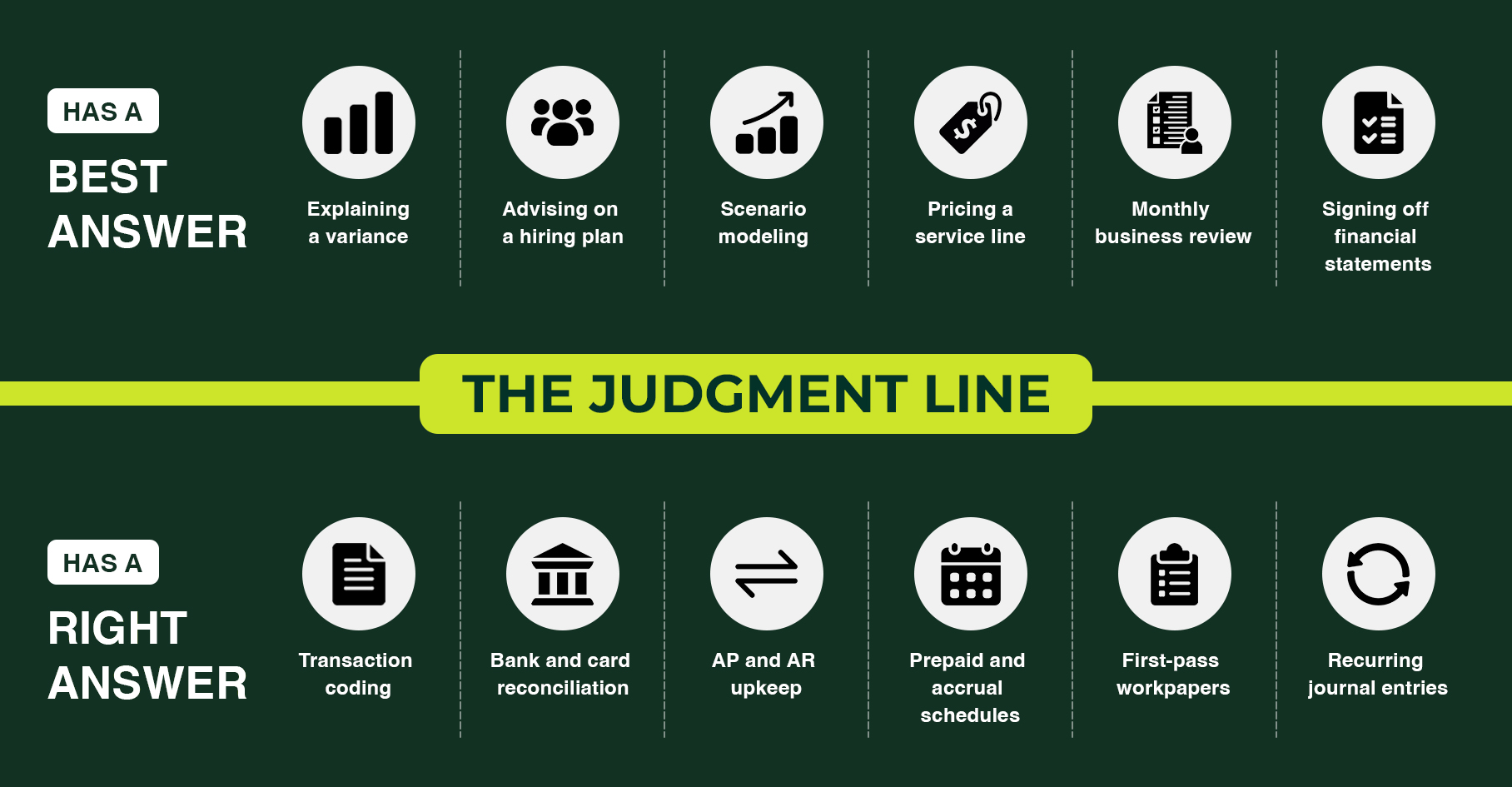
Most firms are surprised by where the line actually falls. Month-end reconciliations sit below it. Explaining a variance to a client sits above it. Preparing a forecast model sits below it. Deciding what the forecast means for a hiring plan sits above it.
Step three: start with one client, not the whole book. Take your highest-volume compliance client and hire one offshore bookkeeper for that work alone. Measure the hours it frees over ninety days. Then reinvest those specific hours into one new advisory offer for that same client, and price it separately.
Ninety days gives you a real number instead of a theory. Once you can say that one placement returned a measurable block of senior hours, and that those hours produced billable advisory work, extending it stops being a leap of faith. It becomes arithmetic.
The Product Was Never the Bookkeeping
Bookkeeping only looked like the product while the books were hard to produce.
Now that they are not, the firms pulling ahead are the ones that stopped defending the price of compliance work and started charging for the thinking that sits on top of it. That move is not primarily a marketing decision or a pricing decision. It is a staffing decision. If your senior people have no time to exercise judgment, you have no judgment to sell.
That is the part we handle. NetBounce Global places dedicated offshore bookkeepers, accountants, and accounting managers inside US firms, so the routine work moves down and your own people move up.
Move the routine work down. Move your people up. The books still get done, and you finally get to sell the part clients actually wanted all along.
Frequently Asked Questions
Offshore accounting is when a US firm hires accounting professionals based in another country to work as part of its own team, rather than employing them locally. The person works your hours, in your accounting software, on your clients, and reports directly to you. A staffing partner handles their payroll, HR, and local compliance, so you add the team member without taking on employment overhead in a foreign jurisdiction. It is different from opening an offshore bank account or an offshore entity, which are unrelated financial arrangements that happen to share the word offshore. In an accounting staffing context, offshore simply describes where your team member is located, not a tax structure.
An offshore bookkeeper handles the transactional layer of your client work: coding transactions, managing bank and credit card feeds, performing monthly reconciliations, keeping accounts payable and receivable current, maintaining prepaid and accrual schedules, and preparing first-pass workpapers for review. In most firms they own the month-end close through to the point where a reviewer picks it up. What they typically do not own is client-facing judgment work, such as explaining a variance, advising on a hiring decision, or signing off on financial statements. That work stays with your onshore team, which is the entire point of the arrangement.
It can be, with the right controls, and you should insist on seeing them rather than hearing about them. Five controls matter. VPN-only access with multi-factor authentication. Work performed inside your own software’s permission structure rather than through shared credentials. No client files stored on personal devices. Individual NDAs signed before anyone touches a client file. And an independent certification such as ISO 27001, which means a third party verified the controls rather than the provider simply describing them. Ask any provider to produce the certificate and to walk you through their access model specifically. A vague answer to that question is itself the answer.
A dedicated offshore bookkeeper typically costs 60 to 70 percent less than an equivalent US hire, with no recruitment fee and no employment administration on your side. The exact figure depends on experience level, software stack, and how many hours of overlap you need with your review team. As a real reference point, one Texas CPA firm moved a $58,000 senior bookkeeping seat to a dedicated offshore seat at $22,000 a year with no drop in quality. The more useful way to evaluate the cost is per freed senior hour rather than per seat, because the return comes from what your onshore team does with the time.
Outsourcing hands a process to a vendor who decides who performs it and how, and returns a deliverable. Offshore staffing gives you a specific named person who works inside your team, your software, and your review process, under your direction. With outsourcing you are buying an output. With offshore staffing you are adding a team member. The practical difference shows up in continuity and control: an outsourced process may be worked by a different person each month, while a dedicated offshore hire learns your clients and your preferences over time. We cover this distinction in full in our guide to offshore versus outsourcing.
On that last point, the longer treatment is in our guide to offshore versus outsourcing, which walks through where each model actually fits.