"We tried offshore before and it didn't work."
We hear this sometimes. And when we dig in, almost every time, what they tried wasn't offshore staffing. It was outsourcing. And they're genuinely not the same thing.
The confusion is understandable — both involve work being done outside your firm, often by people in another country. Both are marketed as solutions to the staffing problem. And because the terminology gets used interchangeably, a lot of firm owners make the wrong choice for their situation, get the wrong result, and write off the whole category.
That's worth clearing up. Because the model that actually works for most accounting firms is nothing like traditional outsourcing.
What Outsourcing Actually Is
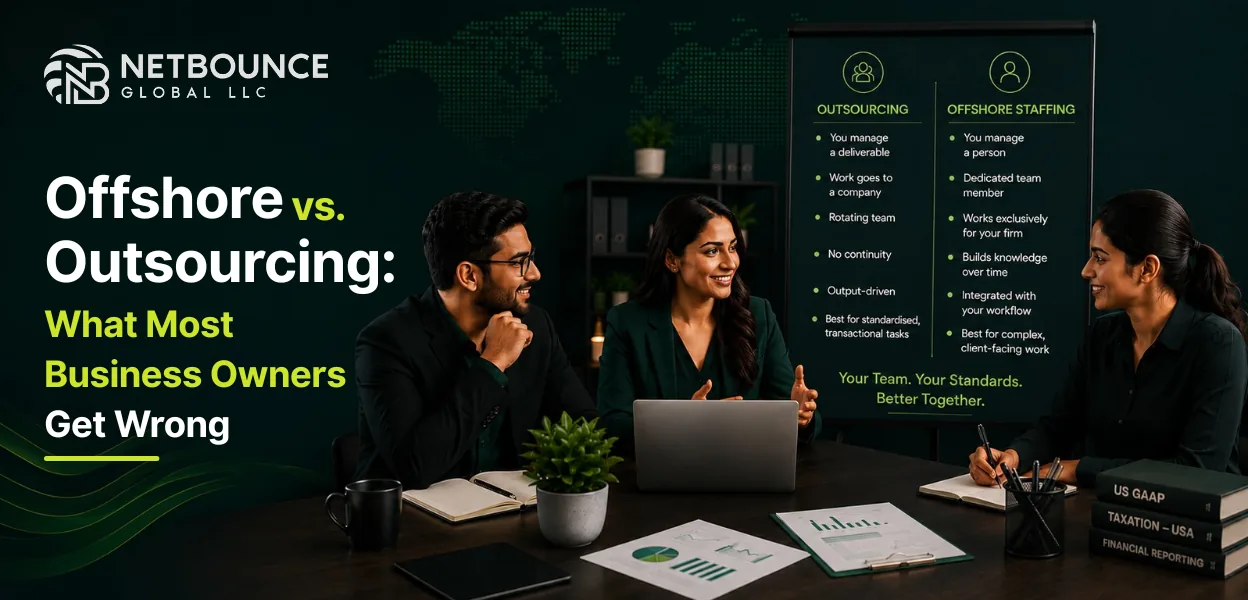
When you outsource a function, you're buying a deliverable. You send work to a company. That company assigns whoever is available to handle it. You receive output. You don't manage the individuals. You don't know which of the company's staff worked on your files. You manage a contract and a service level agreement.
This model works well for things that are highly standardised and easily measured. Document scanning. Data entry. Payroll processing for simple payrolls. Work where individual variation doesn't matter because the task is so clear that almost any trained person can do it the same way.
But accounting work — especially the kind that touches client relationships — is almost never like that. Your clients have specific needs. Your processes have specific ways. The work requires context that takes months to build. And when a rotating pool of anonymous workers handles it, quality is inconsistent, nothing compounds, and the relationship between your firm and whoever is doing the work never actually develops.
What Dedicated Offshore Staffing Actually Is
With dedicated offshore staffing, you're placing a specific person. One person. They work exclusively for your firm — not across a pool of other clients. They attend your team meetings, if you want them to. They use your software. They learn your clients by name. Over time, they develop the kind of institutional knowledge that makes the work genuinely good.
You manage them the same way you'd manage a remote domestic employee. You direct their day, set their priorities, review their work, give feedback. The logistics — employment contract, payroll, HR compliance, benefits in their country — are handled by the staffing provider. You see one clean monthly invoice. But the person is yours.
A dedicated offshore bookkeeper who's been with your firm for a year knows which client always has timing differences on their rent, which account needs a second look before month-end, which partner prefers a certain format for the monthly report. That knowledge doesn't exist in an outsourcing arrangement. It can only exist in a person who shows up every day.
Why the Distinction Matters So Much
The firms that tried outsourcing and got inconsistent results often walked away thinking "offshore doesn't work for accounting." But what they experienced — rotating professionals, no continuity, quality that was fine for simple tasks but fell apart on complex ones — is exactly what you'd expect from the outsourcing model applied to work that requires context and continuity.
The dedicated model is fundamentally different. The person building knowledge of your firm month after month is the thing that makes the quality good. It's the same reason a domestic employee who's been with you for three years is more valuable than a new hire — regardless of where in the world they're located.
If you tried outsourcing and it didn't work, that's useful information. It tells you that your work needs continuity and context — which means dedicated staffing. Dedicated co-sourcing — your team, managed by us. The two are not interchangeable, and the failure of one doesn't predict the success or failure of the other.
How to Know Which Model You Need
The simplest test: do you want to manage a deliverable, or do you want to manage a person?
If you need a batch of documents processed the same way every time and you don't care who does it, outsourcing might work. If you need someone integrated into your team who knows your clients, your standards, and your workflow — who you want to give feedback to and see grow — you need dedicated staffing.
For most accounting firms, bookkeeping practices, and growing businesses, the answer is always dedicated. The work is too specific, too relationship-dependent, too quality-sensitive for an anonymous pool to handle it well. The context that builds up in a dedicated person over six to twelve months is something no outsourcing arrangement can replicate.
Questions Worth Asking
Yes — fundamentally. The quality and consistency problems you experienced with outsourcing are almost always products of the model itself: rotating professionals, no continuity, no institutional knowledge. Dedicated staffing puts one specific person exclusively on your firm's work. The knowledge compounds. The quality improves over time. It's a genuinely different product that produces genuinely different outcomes.
With outsourcing, you manage the contract and the output — you're checking deliverables and filing complaints when quality slips. With dedicated staffing, you manage a person — giving feedback, directing work, watching them grow. Most firm owners who make the switch say managing a dedicated offshore specialist feels almost identical to managing a domestic remote employee.