Suppose you're a CPA, working for a client. Out of nowhere, your department gets hit with an unexpected IRS notice. You start to panic. Papers move faster than thoughts. Your voice raises. You snap at a staffer who was just trying to help.
Now, think for a moment. What could've been a manageable situation — a correspondence letter that needed a measured response within 30 days — has spiraled into a bad afternoon, a worried client, and a staff member quietly updating their resume.
That's the story of emotional intelligence in accounting, in one scene. Being a great accountant isn't just about numbers. It's about staying calm, communicating clearly, and leading with empathy even when things go sideways. That's EQ — and the gap between accountants who have it and the ones who don't is the difference between a firm that keeps clients for a decade and a firm that churns through them.
Why Emotional Intelligence Matters in Accounting
It's easy to assume accounting is a numbers-only profession. It isn't. Accounting is an advisory profession. Which means the output of your work is only valuable if your clients can trust you, understand you, and want to keep working with you. All three of those depend on emotional intelligence, not technical skill.
The best accountants we've seen do a few things consistently:
- They stay calm under pressure — audit notices, missed deadlines, unhappy clients — without transmitting the stress to others
- They read the room. They know when a client needs reassurance versus data, when a staff member is overloaded, when silence means something's wrong
- They communicate the same technical concept three different ways depending on whether the client is a technical finance person, a small business owner, or a nervous first-time filer
- They build genuine relationships. Clients don't just hire them — they refer others and stay with them through life events, business changes, and economic cycles
- They manage teams without burning them out. People want to work for them.
This is why the AICPA has explicitly added communication, collaboration, and professional judgment to its latest Core Competency Framework for accounting — not as soft skills, but as table-stakes capabilities for the modern profession.
What High EQ Actually Looks Like
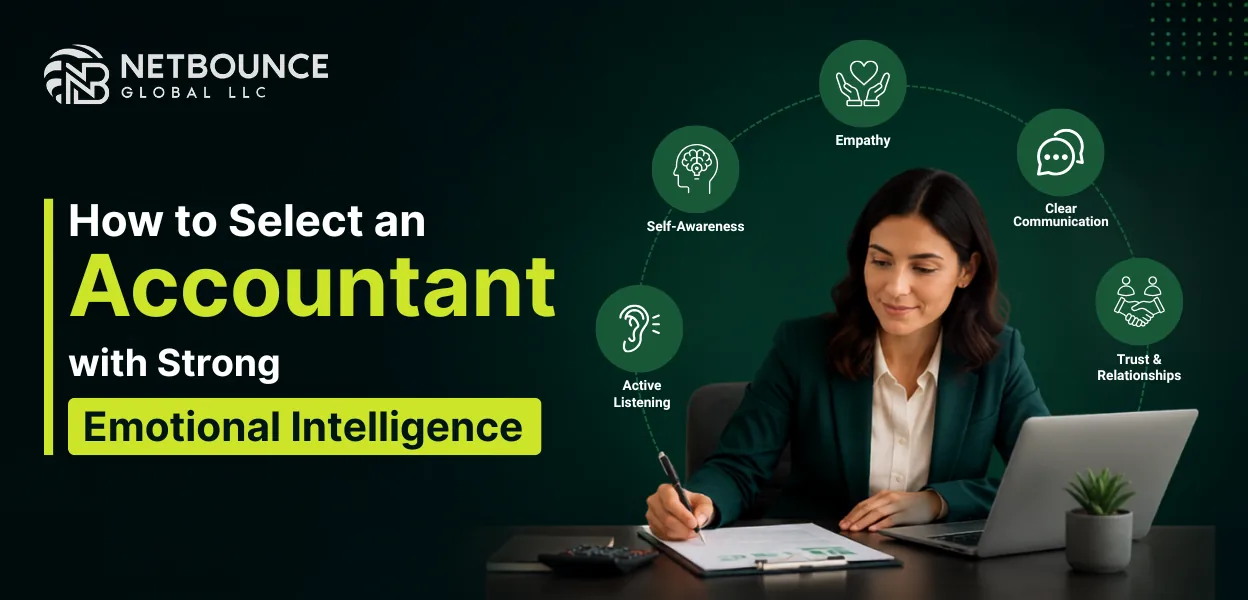
The clinical definition of emotional intelligence includes four domains — self-awareness, self-management, social awareness, and relationship management. But in practical hiring terms, here's what you're looking for when interviewing an accountant:
Concretely, signs of high EQ in accounting candidates show up in small moments:
- They pause before answering hard questions. Not long — just enough to be thoughtful rather than reflexive.
- They reframe mistakes as learnings. When asked about a failure, they describe what they took from it, not just what went wrong.
- They ask good follow-up questions. They're curious about your firm, your clients, your pressure points — not just the job description.
- They're honest about what they don't know. High-EQ candidates say "I haven't done that specific thing, but here's how I'd approach it" rather than bluffing.
- They describe teamwork specifically. They can tell you about a time they helped a colleague, resolved a conflict, or had to deliver hard feedback — with enough detail that you believe it happened.
How to Actually Screen for EQ in Hiring
Technical screens catch technical skill. EQ needs a different approach. Here's what works:
Behavioral interview questions
Ask about specific past situations, not hypotheticals. "Tell me about a time a client was upset with you" reveals more than "how would you handle an upset client?" People rehearse answers to hypothetical questions. They reveal themselves describing actual situations.
Situational judgment scenarios
Present a realistic scenario — a client demanding an aggressive tax position you don't agree with, a junior staff member struggling with an assignment, a deadline that's slipping — and watch how they reason through it. Listen for how they balance stakeholders, not just what decision they make.
Long-form writing samples
Ask them to write a 200-word email explaining a technical concept to a non-technical client. This is the single best test we've found. Technical accuracy, empathy, clarity, tone — all show up in a short piece of writing. EQ shows up in whether they explain the concept at the right level for the reader.
Reference calls with specific prompts
Don't just ask references "was this person good?" Ask "what would you change about how they handled client communications?" or "when did you see them struggle, and how did they respond?" The answers tell you everything about how the candidate operates under pressure.
Specific Questions That Work
A short list of interview questions that reliably surface EQ signal:
- Tell me about a time you had to deliver bad news to a client. How did you prepare for it? What did the conversation look like?
- Describe a situation where you disagreed with a partner or supervisor. How did you handle it?
- Walk me through a time you made a mistake in a client deliverable. What happened next?
- Tell me about a colleague you found difficult to work with. What worked and what didn't?
- When was the last time you genuinely changed your mind about something professionally? What made the difference?
- What does a bad day at work look like for you? How do you recover?
You're not looking for perfect answers. You're looking for self-awareness, specificity, and a pattern of reflection. Candidates who give rehearsed, generic answers to these questions typically lack the EQ to handle real client relationships well.
What to Avoid When Screening for EQ
A few traps that cost firms good hires:
- Overweighting extroversion as EQ. Some of the most emotionally intelligent accountants are quiet. They listen more than they talk. Don't confuse charisma with EQ.
- Dismissing candidates who pause. A thoughtful pause before answering is a good sign, not a bad one. Reflexive answers often mean the candidate isn't actually processing the question.
- Looking for perfect stories. Candidates who describe every past situation as a success usually aren't being honest. EQ shows up in how people describe their struggles, not their wins.
- Using only resume filters. EQ doesn't show up on a resume. It shows up in conversation, writing, and references. If your screen is only resume-based, you'll miss it entirely.
Why This Matters More in 2026
The shift in accounting toward advisory services, client experience, and relationship-based retention makes EQ more important than it was even five years ago. Compliance work — the kind where technical accuracy matters most and relationship quality matters least — is increasingly automated or offshored. What's left at the senior level is the judgment work, the client relationships, the hard conversations. Those all rest on EQ.
When you're hiring an accountant, a bookkeeper, or even a junior preparer, the technical assessment tells you whether they can do the work. The EQ assessment tells you whether they'll still be worth having in three years. Both matter. Don't skip either.
Common Questions About EQ in Accounting Hiring
Not with a single test, but yes — through a combination of behavioral interviews, writing samples, situational judgment scenarios, and structured reference calls. No single technique is perfect. Layered together, they give a reliable signal on how someone will actually handle client work and team dynamics.
They're both necessary. But between two candidates with equivalent technical skill, EQ is usually the deciding factor. And between a technically strong candidate with low EQ and a technically solid candidate with high EQ, we'd bet on the second one to be more valuable three years in.
It can absolutely be developed. Self-awareness grows with reflection. Communication improves with practice. Empathy deepens with exposure. What's harder to change is someone's baseline willingness to reflect and grow — which is why hiring for reflectiveness matters more than hiring for current EQ level.
EQ isn't a cultural or geographic trait. It's a human trait. Our vetting includes structured communication assessment, judgment scenarios, and reference validation — the same framework we'd use for a domestic hire. Candidates who lack EQ are filtered out at the same rate regardless of where they're based.
"Tell me about a time you got something wrong at work. What happened, and how did you respond?" Listen for ownership, specificity, what they learned, and how they handled the people affected. The answer reveals self-awareness, accountability, communication, and recovery — all at once.