Modern accounting firms aren't looking for someone to simply record transactions anymore. They're looking for professionals who can run an entire tech stack.
Your clients now operate across multiple entities, sell through Shopify, collect through Stripe, pay vendors through Bill.com, process payroll through Gusto or ADP, and send financials to investors through Fathom or LivePlan. To keep that ecosystem in sync, you don't need someone who can post entries. You need someone who can automate, reconcile, and optimize — a bookkeeper who thinks in systems, not just ledgers.
That's a fundamentally different profile than the bookkeeper role of even five years ago. And finding one in the domestic market is close to impossible right now. Which is why we've built the vetting process we have — because if you're going to place someone inside a CPA firm that runs on automation, they need to be qualified to run the automation, not just survive it.
Why We Rebuilt Our Vetting Process
The old offshore staffing playbook was volume-based. Screen hundreds of candidates on résumés and basic technical questions, place the ones who pass, hope for the best. That model breaks the moment a firm's tech stack gets sophisticated. A candidate who can list "QuickBooks Online" on their résumé is not the same as a candidate who can reconcile a multi-entity Shopify ledger with five Stripe accounts feeding into a consolidated parent book.
So we rebuilt the entire process around one question — can this person actually do the job in a modern firm, on day one, without supervision?
Our current reject rate is over 96%. That's not a marketing number. That's what it takes to get a candidate pool that can operate at the level firms running automation stacks need.
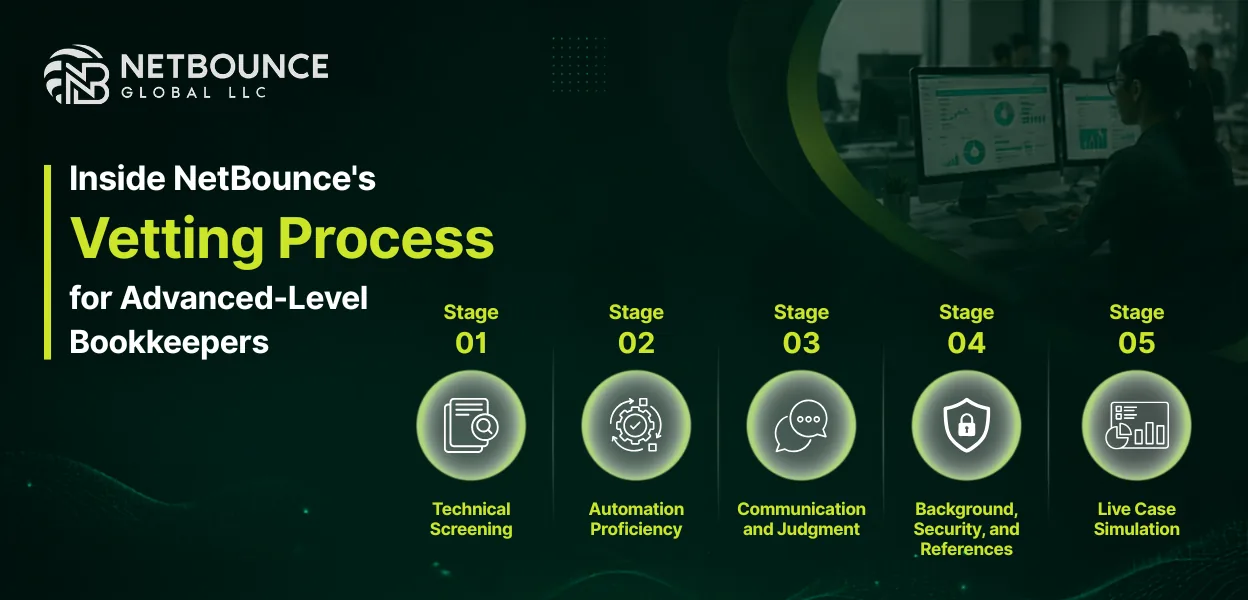
Stage 1 — Technical Screening
Every candidate starts with a technical test that mirrors real CPA firm challenges. Not theoretical questions. Actual scenarios pulled from work our placed specialists do every week.
An example from our current assessment:
We're not looking for the textbook answer. We're looking for how the candidate thinks through the ambiguity. Do they ask the right follow-up questions? Do they identify edge cases? Do they know when to flag something for the partner review versus solve it independently?
This stage alone eliminates roughly 70% of applicants.
Stage 2 — Automation Proficiency
We don't rely on self-reported skills. Every candidate who passes Stage 1 demonstrates live integration proficiency across the tools that actually matter in 2026 — connecting Bill.com, QuickBooks Online, payroll platforms, and bank feeds in real time.
The test looks like this. We give them a sandbox environment with three apps already misconfigured. They have 45 minutes to identify what's broken, fix it, build automation rules to prevent the issue from recurring, and document the fix for the firm's records. We watch how they work.
The tools we assess against reflect what U.S. firms are actually running:
- Core books: QuickBooks Online, Xero, Sage Intacct
- AP/AR automation: Bill.com, Ramp, Brex, Melio
- E-commerce integrations: Shopify, Stripe, Amazon Seller Central, A2X
- Payroll: Gusto, ADP, Paychex, Rippling
- Reporting: Fathom, LivePlan, Reach Reporting
- Close tooling: Karbon, Jirav, FloQast (where applicable)
By the time a candidate passes Stage 2, we already know they can walk into a firm's stack and be productive in week one — not month three.
Stage 3 — Communication and Judgment
Technical skills are necessary. They're not sufficient. A bookkeeper who can reconcile anything but can't write a clear Slack message to the partner about a flagged transaction is a liability, not an asset.
Stage 3 is a structured communication assessment. Written English proficiency. How clearly they explain a technical issue in plain language. How they handle ambiguous instructions from a (simulated) firm partner. How they escalate appropriately versus solve independently.
We also test judgment under pressure. A specialist who freezes when something looks off — or worse, makes an unauthorized adjustment to make the numbers work — is a risk we won't place. We want people who pause, flag, and ask.
Stage 4 — Background, Security, and References
Every candidate who reaches Stage 4 goes through a formal background check, identity verification, and reference calls with two previous supervisors. Because they'll have access to client financial data, we also verify they can work from a secure environment — which for our specialists means a NetBounce-managed laptop with endpoint protection, VPN enforcement, and device-level encryption.
This is also where ISO 27001:2022 compliance kicks in. Our information security management system is independently audited, and every specialist we place operates inside its controls. That's not a marketing claim — it's verified annually by an accredited certification body, and we can provide the audit report on request.
Stage 5 — Live Case Simulation
The final stage is a two-week paid simulation where the candidate works on sanitized but realistic client data under the supervision of a NetBounce manager. We assess real output quality, not test performance. How clean are their workpapers? How accurate are their reconciliations? How well do they respond to mid-stream changes in scope? How do they handle a partner who's terse in feedback versus one who's detailed?
Candidates who pass Stage 5 enter our placement pool. Everyone else gets detailed feedback and either a pathway to retry in 6 months or a clean "not a fit" explanation.
What This Means for Your Firm
When you onboard a NetBounce bookkeeper, you're not onboarding a generalist. You're onboarding someone who has already demonstrated they can run a modern automation-first tech stack, handle multi-entity consolidations, escalate ambiguity appropriately, work securely inside a compliance framework, and produce clean output under real-world pressure.
That's why our clients typically see their specialist fully productive inside two weeks, not two months. The vetting is the investment that makes the placement fast.
It's also why we can offer a placement guarantee — if within the first 90 days you decide a specialist isn't the right fit, we replace them without charge. The confidence comes from knowing the vetting actually filters.
Questions We Get About Vetting
Yes, always. Every candidate we send is available for your firm's own interview and technical assessment. You're not committing by reviewing profiles. Many firms have their own favorite test for QBO or Bill.com — run it. The better the two-sided fit check, the better the placement holds.
Yes. Candidates are tagged by industry fluency — SaaS revenue recognition, e-commerce multi-channel reconciliation, real estate / property management, professional services, nonprofit. When you share your client mix with us, we match to candidates whose experience aligns.
You never see them. Our vetting happens before you do. The profiles you review are only the candidates who passed all five stages. That's the entire point — we put the filter in front, so your hiring decision is a fit decision, not a quality decision.
Volume-based providers typically place 60-70% of applicants. We place under 4%. That's the difference, numerically. Every candidate you see from us has passed technical scenarios, live automation assessments, communication testing, background checks, and a two-week paid simulation. The rejection rate is the moat.
We replace them at no cost within the first 90 days. After that, you can request a replacement anytime with reasonable notice. We also do monthly check-ins with both you and the specialist to catch issues early — most problems are fixable if they're caught in week three, not month three.