Most CPA and accounting firms do not struggle to hire because qualified bookkeepers are unavailable. They struggle because hiring gets treated as an emergency instead of a process.
The pattern repeats yearly. Busy season exposes a capacity gap, a partner screens resumes between client calls, hires whoever is available in March, then spends a quarter reviewing the work. This guide covers how to hire a bookkeeper properly, in seven steps, written for firm owners rather than small business owners.
The Short Answer
To hire a remote bookkeeper: scope the role precisely, decide which market you are hiring from, source pre-vetted candidates, match on software rather than years of experience, run a paid trial, put contracts and security controls in place, then onboard properly in week one. Most firms complete this in two to four weeks.
If the seat you are filling sits a level above bookkeeping, the scoping and screening change with it. We cover that in hiring a remote staff accountant, which includes a copy-paste JD template and 12 interview questions.
When Should Your Firm Hire a Bookkeeper?
Knowing when to hire a bookkeeper is an operational question, not an emotional one. Consider it when partners or senior staff perform work billing well below their rate, when you have declined client work you could have delivered, when reconciliations slip past the tenth of the month, or when busy season demands overtime your team cannot repeat.
Waiting carries a cost. Accounting roles take months to fill in most US markets, and every open week is capacity you are not billing, as we examined in The 73-Day Problem. If two or more signals apply today, your firm is already behind.
Step 1: Scope the Role Before You Post It
Vague job descriptions attract vague candidates. Before writing anything, list the work you want moved off your team: bank reconciliations, accounts payable, month-end close, cleanup projects, or a defined book of client accounts.
Then set the level. A full-charge bookkeeper owns the close and produces financials. A transactional bookkeeper handles volume under supervision. The two are not interchangeable, and choosing wrong is the most common mistake we see. Define the role around the work, not the title. If you are still deciding whether the seat is a bookkeeper at all, the 30-Day Rule for choosing a bookkeeper before an accountant settles the order.
Step 2: Decide Where You Are Hiring From
Three realistic options exist. Local hiring offers proximity at the highest cost and smallest pool. Remote domestic widens the pool but keeps US salary expectations. Hiring an offshore bookkeeper opens a substantially larger pool of US-GAAP-trained professionals at roughly 60 to 70 percent less than a domestic hire.
For most firms the deciding factor is availability, not cost. If you have searched locally for two months without a qualified shortlist, the market has answered.
Step 3: Source Pre-Vetted Candidates
Job boards place the screening burden entirely on your firm. A staffing partner should deliver candidates who have already passed technical assessment before reaching your inbox.
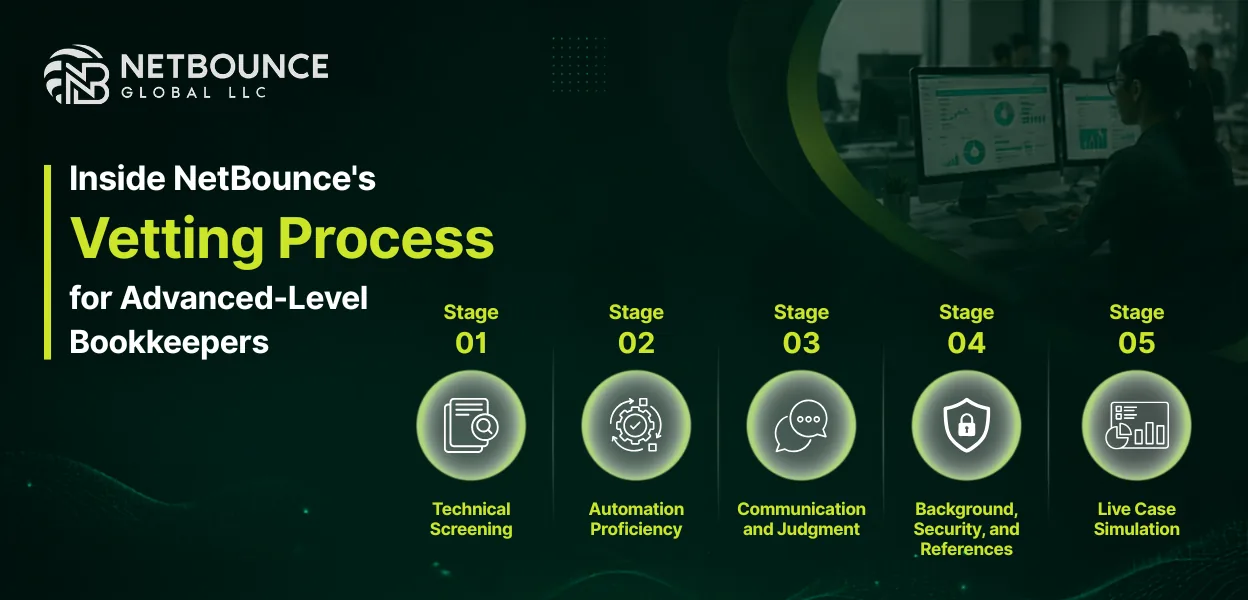
Ask what pre-vetted actually means. The answer should include software proficiency testing on real client files, English fluency assessment, and background verification, not a resume review and one phone call. If a provider cannot describe screening in specific terms, assume it is shallow. Ours is broken down in detail here.
Step 4: Match on Software, Not Years of Experience
Stack fluency matters more than tenure. A bookkeeper with eight years in Sage will slow your firm down if your clients run on QuickBooks Online and your tax team works in Lacerte.
Match on the software your firm uses, including the automation on top of it: QuickBooks, Xero, Bill.com, Dext. Ask candidates to demonstrate the work rather than describe it. A QuickBooks specialist who knows your stack contributes in week two rather than month two.
Step 5: Run a Paid Trial Before You Commit
Interviews reveal communication. Paid trials reveal competence. The questions to ask when hiring a bookkeeper matter, but what a candidate produces matters more.
Give a shortlisted candidate two to three days of real work under supervision: a live reconciliation, a single-entity close, or a cleanup on a messy account. Assess three things. Is the work accurate without hand-holding? Do they flag what looks wrong? Do they document what they did?
Pay for the trial. Candidates worth hiring do not work for free, and the cost is negligible against a bad hire.
Step 6: Get the Contract and Security Right
Client financial data raises the stakes. Before anyone touches a file, confirm controls in writing.
Require an individual non-disclosure agreement for the person, not only the provider. Confirm access runs through a VPN with multi-factor authentication and that no client data sits on personal devices. Ask whether the provider holds ISO 27001 certification, the international standard for information security management. Confirm replacement terms too. If a placement fails, you need a defined path, not a negotiation.
Step 7: Onboard Properly in Week One
Most remote hires fail in week one, not month six.
Provide documented processes rather than verbal instruction, grant system access on day one, and assign a named point of contact. Set a review cadence: daily for the first week, then weekly through month one.
Expect a realistic ramp. A strong bookkeeper contributes within two weeks and reaches full independence around 60 to 90 days. Onboard during a quieter stretch so they are productive before your next peak.
What Does It Cost to Hire a Bookkeeper?
A full-time US bookkeeper costs roughly $55,000 to $70,000 annually in salary, before payroll taxes, benefits, software licences, and recruitment fees. Fully loaded, most firms spend closer to $75,000.
A dedicated remote bookkeeper costs 60 to 70 percent less. The larger expense is usually the vacancy itself. An unfilled seat through busy season means declined engagements and overtime, which rarely appears in a hiring budget but shows clearly in realization. Full numbers here.
How NetBounce Global Helps
Finding a competent bookkeeper is straightforward. Finding one who already knows your software, your review process, and US GAAP is where firms lose a season.
NetBounce Global places dedicated remote bookkeepers with CPA and accounting firms across the US. Rates start at $10 per hour, with no recruitment fees and no benefits load.
How It Works
- Discovery call. We scope the role, your software stack, and how you review work.
- Profiles in 48 hours. Pre-vetted candidates matched to your requirements, not a resume pile.
- You interview and decide. Run a paid trial before committing if you want to see the work first.
- Onboarding support. Most placements are working in client files within about four days.
Every placement is dedicated to one firm, pre-vetted on your stack, and covered by ISO 27001 controls, VPN-only access, MFA, and individual NDAs.
Conclusion
Hiring a bookkeeper is not difficult when it is run as a process. The firms that struggle are improvising under deadline pressure in March.
Scope the role precisely, hire from the market where qualified people are, test before you commit, and onboard with structure. Do that, and the seat gets filled once rather than twice.
Frequently Asked Questions
Scope the role around specific work, choose your hiring market, source pre-vetted candidates, match on software fluency, run a paid trial, confirm contracts and security controls, then onboard with documented processes in week one.
When partners or senior staff are doing work that bills below their rate, when you have declined client work you could have delivered, or when reconciliations consistently slip past month-end. Two or more signals means you are already behind.
A full-time US bookkeeper costs roughly $75,000 fully loaded, including salary, taxes, benefits, and recruitment. A dedicated remote bookkeeper typically costs 60 to 70 percent less, depending on experience and scope.
Ask which software they have used on live client files, how they handle a transaction they cannot categorise, how they document their work, and what their month-end close looks like. Then verify with a short paid trial.
Hire a bookkeeper for transaction processing, reconciliations, and month-end close. Hire an accountant for advisory work and tax strategy. Most firms need bookkeeping capacity first, because that is the work consuming senior time.
A traditional domestic search often runs two to three months. With a partner maintaining pre-vetted candidates, most firms review profiles within 48 hours and have someone working within a week.