Most firms hiring a remote staff accountant start the same way. They open the last job description they used, add the word “remote,” and post it.
Then forty applications land, and every one of them looks the same. Same bullet about reconciliations. Same “proficient in QuickBooks.” Same “detail-oriented team player.” There is no way to tell who can actually close a month and who has only watched someone else do it.
That is not a candidate problem. It is a job description problem, followed by an interview problem.
Hiring in person gives you a gut check for free. You watch someone think. You see how they react when they get something wrong in a room full of people. Remote hiring takes all of that away. Your job description and your interview have to carry weight they never had to carry before.
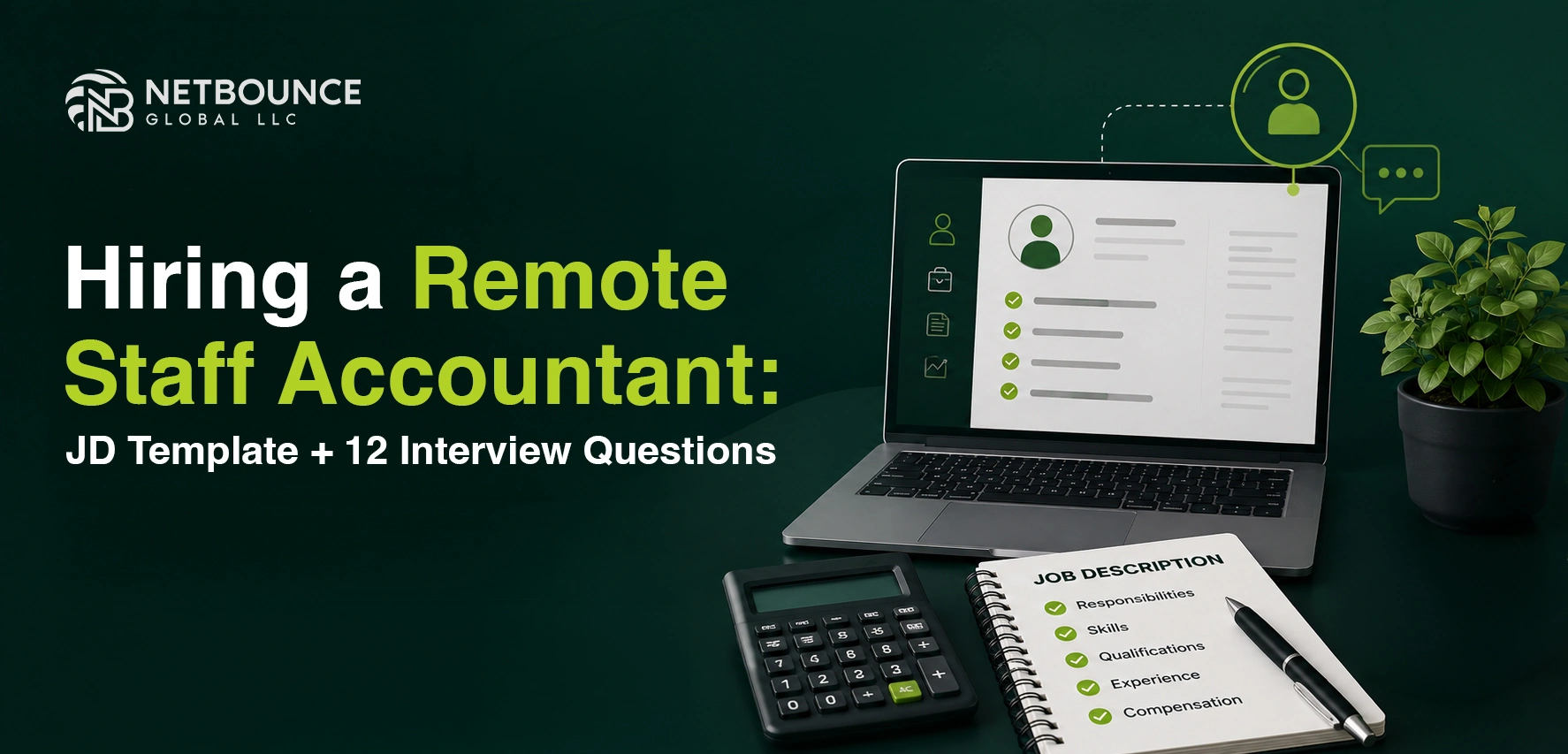
So this detailed blog hands you four things: a copy-paste job description template, a clean split between must-have and nice-to-have skills, a software checklist that goes deeper than logos, and 12 interview questions built to show you whether someone really understands GAAP and reconciliation work.
What a Remote Staff Accountant Actually Covers
A staff accountant owns the general ledger work that turns raw transactions into financial statements. That means journal entries, account reconciliations, month-end close support, AP and AR assistance, and the schedules and reports a reviewer signs off on.
The confusion usually sits on either side of the role. Both lines are worth drawing clearly.
An offshore bookkeeper sits below it. That work is transactional and continuous: coding transactions, managing bank feeds, keeping AP and AR current. A bookkeeper keeps the data accurate. A staff accountant takes that data and makes accounting decisions with it, including accruals, deferrals, prepaid schedules, and fixed asset entries.
An accounting manager sits above it. That role reviews, approves, and owns the close calendar. They are accountable for whether the numbers are right. The staff accountant is accountable for producing them and flagging what looks wrong.
If you are still deciding which of those three rungs you actually need, we work that choice through in junior accountant vs senior accountant vs accounting manager, using weekly review hours as the deciding number.
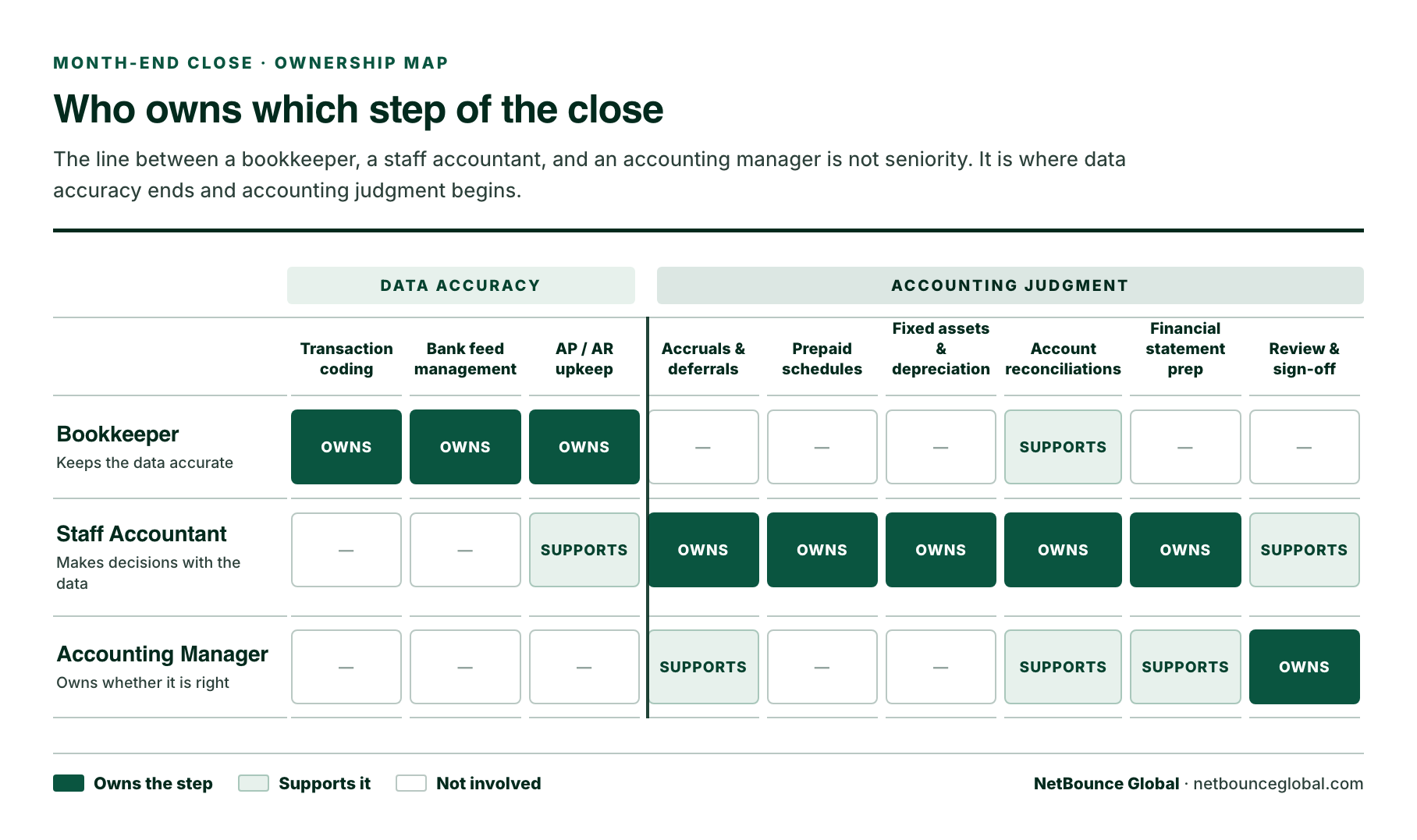
Here is the part that matters for hiring. Going remote does not change what the work is. It changes how the work gets verified.
In an office, a reviewer catches a bad accrual by glancing at a screen. Remotely, nobody glances at anything. Verification happens through documentation. That means clear workpapers a reviewer can follow, and a person who raises a hand in writing before a wrong entry gets posted rather than after.
That is why three of the twelve questions below test communication instead of accounting. In a remote seat, the ability to escalate clearly is a technical control.
The Job Description Template
Two things break most staff accountant job descriptions. They describe activity instead of ownership, and they list software as logos instead of depth. This template fixes both.
Use it as a starting point for a dedicated remote staff accountant and adjust it to your client mix. For the same treatment on a more junior seat, see our full hiring process for remote bookkeepers.
Title and one-line summary
Keep the title plain. “Remote Staff Accountant” works. Resist “Accounting Rockstar,” and resist bundling two roles into one title. If you cannot say what the person owns in a single sentence, the role is not defined yet.
Core responsibilities
Six to eight lines. Start each one with a verb of ownership rather than participation.
- Prepare and post journal entries, including accruals, deferrals, and prepaid amortization schedules
- Perform monthly balance sheet account reconciliations and resolve reconciling items to zero
- Support the month-end close calendar and deliver assigned schedules by the agreed close day
- Maintain fixed asset registers and record depreciation entries
- Assist with AP and AR workflows, including vendor and customer account analysis
- Prepare supporting schedules and draft financial statement packages for review
- Document workpapers so a reviewer can follow the work without a live conversation
- Flag discrepancies, unusual variances, and unclear transactions before close, in writing
Most firms leave out that last bullet. Put it in. It sets the remote expectation on day one, and it gives you something concrete to point to in a performance conversation later.
Must-have vs. nice-to-have
Splitting these does two jobs. It stops good candidates from ruling themselves out over a preference, and it stops you paying a premium for something you never needed.
| Must-have | Nice-to-have |
|---|---|
| 2+ years performing balance sheet account reconciliations | CPA-track, CA, or equivalent qualification in progress |
| Working GAAP fluency across accrual basis, revenue and expense recognition, and prepaid and accrued treatment | Industry-specific experience in real estate, e-commerce, professional services, or construction |
| Hands-on month-end close exposure, not just data entry | Multi-entity or consolidation experience |
| Ability to build and defend a reconciliation independently | Prior experience on a distributed or offshore team |
| Written English clear enough to document workpapers and escalate issues | Exposure to automation tooling such as Dext, Bill.com, or Ramp |
| Verifiable overlap with your review window | Audit support or PBC preparation experience |
The CPA question comes up on nearly every brief, so it is worth answering directly. For a staff accountant seat, credential status is a genuine nice-to-have. Two years of real close experience beats a credential with no close reps behind it. Make it a must-have only if your client work requires it.
Software checklist
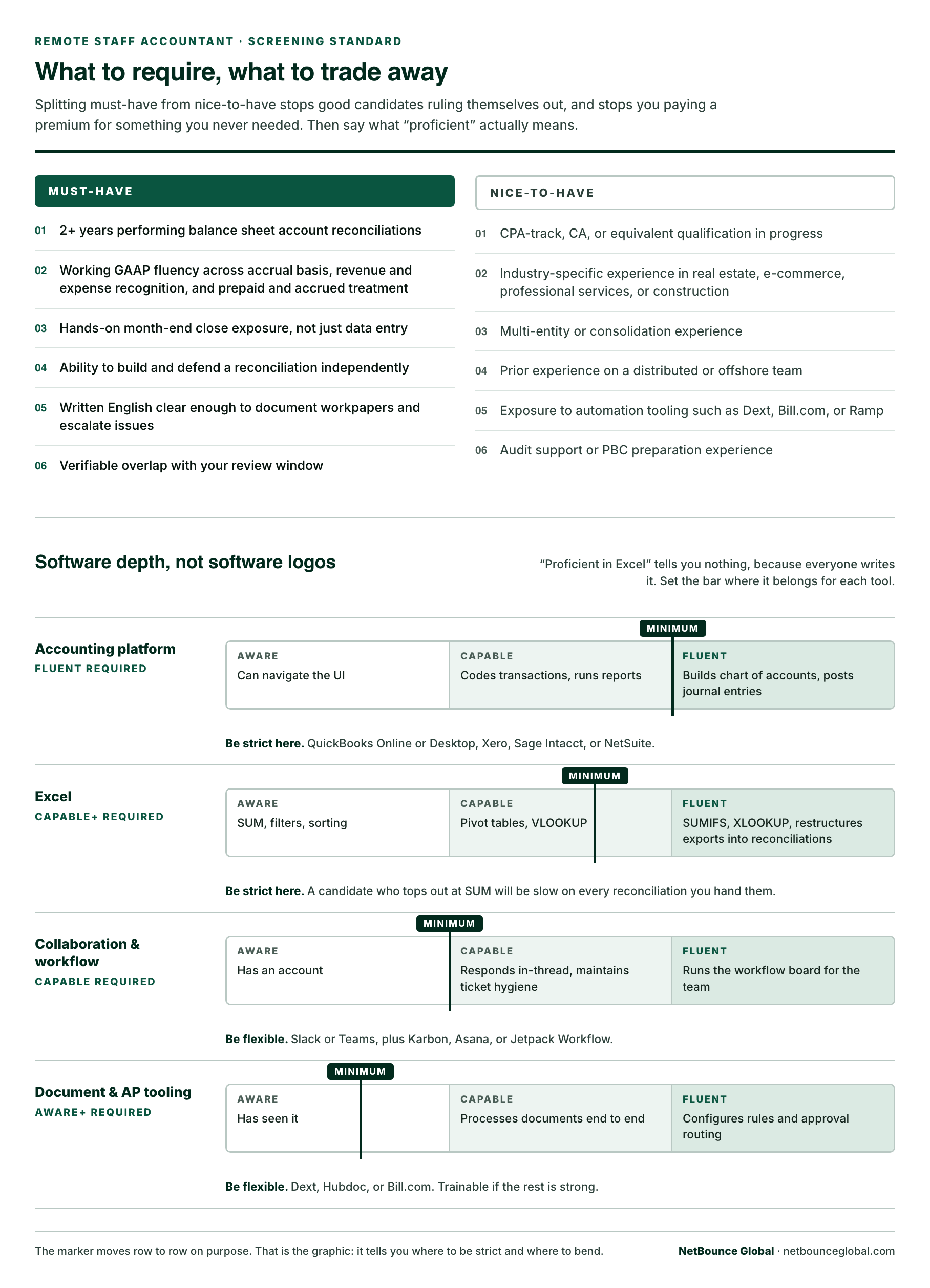
List software by depth, not by logo. “Proficient in Excel” tells you nothing, because everyone writes it. Say what proficient means.
Accounting platform. QuickBooks Online, QuickBooks Desktop, Xero, Sage Intacct, or NetSuite. You want a level that covers chart-of-accounts structure and journal entry posting, not just transaction coding. If your stack is QBO-heavy and the cleanup work is significant, you may want a QuickBooks specialist instead of a generalist.
Excel depth. Pivot tables, SUMIFS, XLOOKUP, and enough comfort to restructure an export into a usable reconciliation. Power Query is a bonus. If a candidate tops out at SUM and manual filtering, they will be slow on every reconciliation you hand them.
Collaboration and workflow. Slack or Teams, plus a workflow tool such as Karbon, Asana, or Jetpack Workflow. Remote work runs on written updates and clean ticket hygiene.
Document and AP tooling. Dext, Hubdoc, or Bill.com, depending on your stack.
Copy-paste block
Replace the bracketed fields and post it.
REMOTE STAFF ACCOUNTANT

Own the general ledger, reconciliations, and month-end close support for a
portfolio of [X] client accounts. Work [hours] with [X] hours of overlap
with our [time zone] review team.

RESPONSIBILITIES
- Prepare and post journal entries, including accruals, deferrals, and
  prepaid amortization schedules
- Perform monthly balance sheet account reconciliations and resolve
  reconciling items to zero
- Support the month-end close calendar and deliver assigned schedules by
  close day [X]
- Maintain fixed asset registers and record depreciation entries
- Assist with AP and AR workflows, including vendor and customer account
  analysis
- Prepare supporting schedules and draft financial statement packages
  for review
- Document workpapers so a reviewer can follow the work without a live
  conversation
- Flag discrepancies, unusual variances, and unclear transactions before
  close, in writing

REQUIRED
- 2+ years performing balance sheet account reconciliations
- Working GAAP fluency: accrual basis, revenue and expense recognition,
  prepaid and accrued treatment
- Hands-on month-end close experience
- Proficiency in [QuickBooks Online / Xero / Sage Intacct / NetSuite]
- Excel: pivot tables, SUMIFS, XLOOKUP, restructuring exports into
  reconciliations
- Written English sufficient to document workpapers and escalate issues
  clearly
- Consistent availability during [X:00-X:00 time zone]

PREFERRED
- CPA-track, CA, or equivalent qualification in progress
- Experience in [your client industry]
- Multi-entity or consolidation experience
- Prior distributed or offshore team experience
- Exposure to [Dext / Bill.com / Ramp / your automation stack]

HOW WE WORK
[One short paragraph: your close calendar, your review process, your
communication norms, and what overlap you expect. Candidates screen
themselves out here, which saves you interviews.]
That last section does more work than people expect. A candidate who cannot work your overlap window will withdraw before you spend an hour on them.
12 Interview Questions That Expose GAAP and Reconciliation Depth
“Walk me through your experience” rewards the candidate who rehearsed a good summary. It tells you nothing about who can do the job. Every applicant has an answer ready, and the answers are interchangeable.
Remote hiring makes this worse. You have lost the informal signals, like how someone reacts when they get stuck, or whether they ask before assuming. You have to build those signals into the questions themselves.
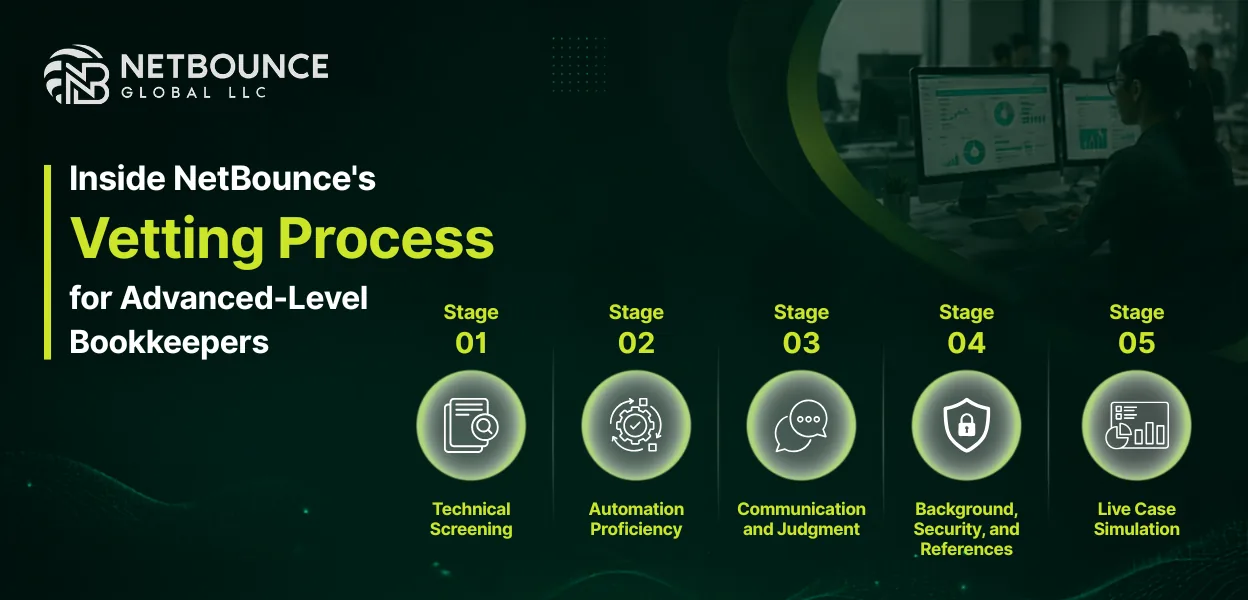
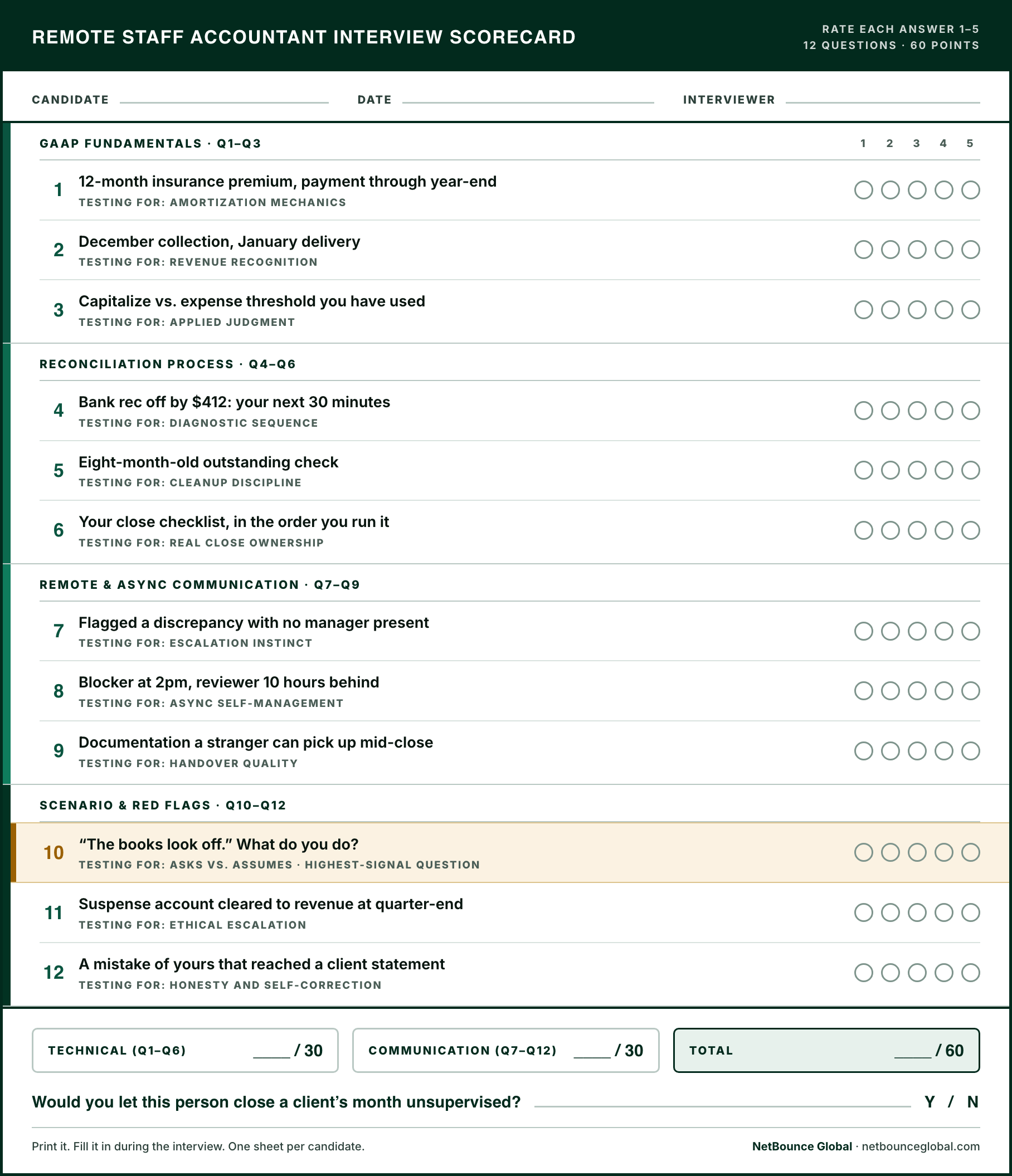
The twelve below sit in four buckets of three. Ask all twelve, or use one bucket per round. Every question has a wrong answer, and that is what makes it useful. It is the same principle behind how we vet for automation-heavy firms.
GAAP fundamentals
1. A client pays a 12-month insurance premium in full in March. Walk me through every entry from payment through year-end.
Strong answer: debit prepaid and credit cash at payment, then a monthly entry expensing one-twelfth, with a specific remaining balance at year-end. Weak answer: “It goes to prepaid and then we expense it.” No monthly mechanic, no year-end number.
2. A client invoices and collects in December for services they will deliver in January. How do you record it, and what changes if they are on a cash basis for tax?
3. Give me a threshold you have actually used for capitalizing versus expensing an asset, and tell me who set it.
Reconciliation process
4. A bank reconciliation is off by $412. You have checked it twice and cannot find it. Walk me through your next thirty minutes.
Strong answer: a real sequence. Search for $412 or $824 as a single transaction. Test for a transposition by dividing by 9. Isolate the period. Compare the prior month’s cleared balance. Check for a duplicate or a sign flip. Then time-box it and escalate with documentation. Weak answer: “I’d go through it line by line again.” That is repetition, not process.
5. There is an outstanding check on the reconciliation that has been sitting there for eight months. What do you do with it?
6. Describe your month-end close checklist in the order you actually run it.
Remote work and async communication
7. Tell me about a time you found a discrepancy and had to flag it with no manager in the room.
Strong answer: a specific instance with a real number, what they wrote, who they sent it to, and what happened next. The best version includes a time they were wrong and said so. Weak answer: “I always communicate issues to my supervisor,” stated as a policy rather than an event.
8. You are ten hours ahead of your reviewer. At 2pm your time you hit a blocker that stops the close. What do you do for the rest of your day?
9. How do you document your work so that someone can pick it up mid-close without calling you?
Scenario and red-flag questions
10. A client’s books look off. What do you do?
The vagueness is the test. Strong answer: questions back. Off in what way? Which period? What changed? Is there a prior clean close to compare against? Weak answer: a confident plan built on assumptions the candidate invented, without ever asking what “off” means. In a remote seat, someone who guesses instead of asking will produce confidently wrong work for weeks before anyone notices.
11. You notice that entries have been posted to a suspense account and cleared to revenue at quarter-end. What do you do?
12. Tell me about a mistake of yours that made it into a delivered financial statement. What happened afterward?
Question 12 is underrated. Anyone with real close experience has one. Candidates who claim a spotless record are usually telling you they have never owned anything.
Red Flags Specific to Remote Hiring
Three signals matter more remotely than they do in person.
Process described as outcome. “I reconciled the accounts every month” is a result. “I pulled the bank feed, matched against the GL, isolated timing differences, then cleared the rest” is a process. You cannot watch someone work remotely, so the description is all you get. If they cannot describe the mechanics, assume they were handed a workflow rather than building one.
No questions asked back. In an async-heavy role this is a hard signal, not a soft one. Someone who gets through an entire interview without asking about your close calendar or your stack will not ask about an ambiguous transaction either. They will guess, and you will find it three months later.
Software named without depth. “I’ve used NetSuite” means nothing on its own. Follow up. Which module? What did you do in it? What did you find annoying about it? A real user has opinions about their tools. Someone who watched a colleague use it does not.
DIY Hiring vs. a Staffing Partner
Both paths work. The difference is mostly time.
Time to hire. Running it yourself means writing the JD, posting it, screening near-identical resumes, running first-round interviews, running technical rounds, checking references, and negotiating. Filling an accounting seat in the US currently averages 73 days. A staffing partner compresses that because the screening already happened. The shortlist is the first thing you see, not the last.
Vetting depth. A DIY process gives you one or two conversations and a reference call. A serious partner process gives you software-matched candidates who have already been technically assessed, communication-tested, and background-checked. Ask any provider what percentage of applicants they reject and what the assessment actually tests. A vague answer there is the whole answer.
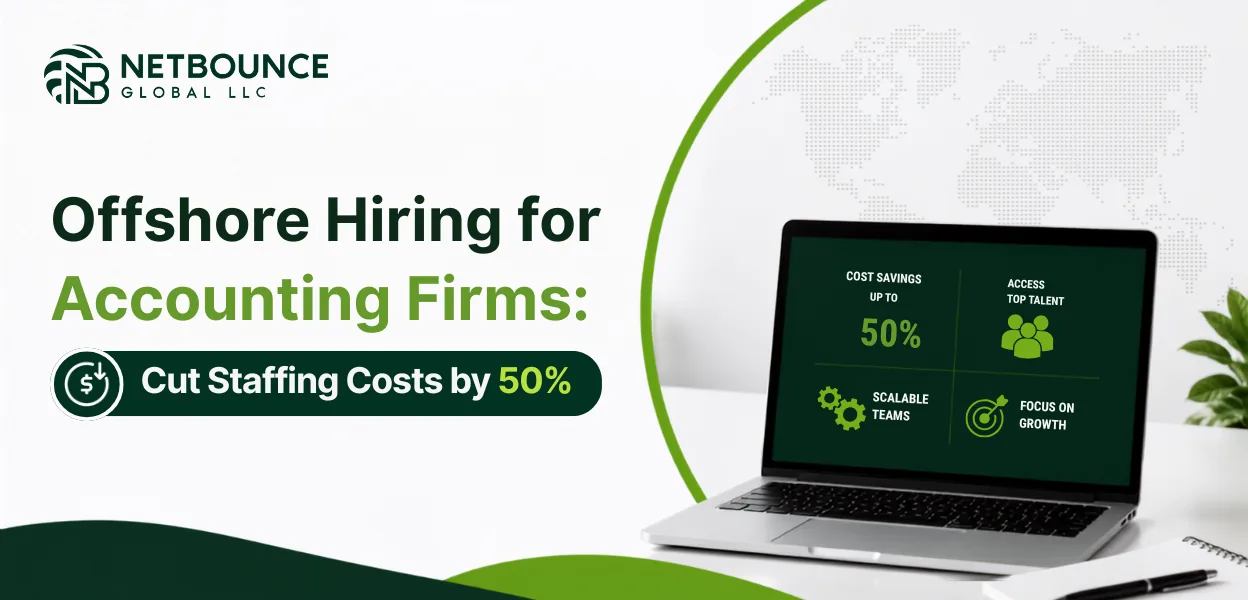
Cost. Robert Half’s 2026 Salary Guide puts a US staff accountant’s base salary between $61,000 and $87,750, with a national midpoint of $73,750. Fully loaded with payroll tax, benefits, and HR overhead, the true cost runs about 1.4 times base, which is roughly $85,000 to $123,000, or about $103,000 at the midpoint. A dedicated offshore staff accountant through NetBounce Global runs about $27,000 to $34,000 all-in, roughly 60 to 70 percent below the loaded domestic cost, with no recruitment fee and no employment administration on your side. The arithmetic is in the full cost breakdown.
The honest version of our pitch is narrow. This is a staffing model, not an outsourcing arrangement. You are not sending work to a rotating pool. You hire one dedicated person who works your hours, in your software, on your clients, reporting to you. We handle payroll, HR, compliance, and replacement behind it. If you would rather run the search yourself, the template and the twelve questions above are the whole kit. They work either way.
Questions Firms Ask Before They Post the Role
Robert Half’s 2026 Salary Guide puts a US staff accountant’s base salary between $61,000 and $87,750, with a national midpoint of $73,750. Fully loaded with payroll tax, benefits, and HR overhead, the real cost is about 1.4 times that, or roughly $85,000 to $123,000. A dedicated offshore staff accountant typically costs 60 to 70 percent less, in the region of $27,000 to $34,000 all-in, with no recruitment fee. The exact figure depends on experience level, software stack, and required overlap hours.
A bookkeeper handles transactional work: coding, bank feeds, and AP and AR upkeep that keeps the file clean and current. A staff accountant makes accounting decisions on top of that data, including accruals, deferrals, prepaid schedules, fixed assets, reconciliation resolution, and month-end close support. If your books are accurate but close still takes too long, you need a staff accountant. If transactions are piling up uncoded, you need a bookkeeper first.
Hiring domestically, expect roughly 73 days from posting to start date, plus four to eight weeks of ramp before the person is independently productive. Through a staffing partner with a pre-vetted pool, the same seat can be filled far faster. NetBounce Global delivers profiles within 48 hours and places candidates in about four days, because the screening is already done before you see anyone.
With the right controls, yes. Look for an ISO 27001:2022 certified operating environment, VPN-restricted access with no direct connection from personal devices, MFA on every platform, individual NDAs signed before anyone touches client data, and no client files stored locally. Ask any provider to show you the certificate and describe the access model. If they cannot, that is your answer.
For a staff accountant seat, usually not. The role produces the work that a licensed reviewer signs off on, so credential status is a nice-to-have rather than a requirement. Two years of genuine month-end close experience predicts performance better than a credential with no close reps behind it. Make it a hard requirement only if your specific client engagements demand it.
On the security question, we set out the full control model in the complete answer on offshore accounting data security, including what an ISO 27001:2022 certified environment actually commits a provider to.