Offshore accounting gets pitched as secure in almost every sales deck. Few providers can back that claim with anything you can actually verify. Before a client’s financial data moves to an offshore team, you need a straight answer to one question: where does that data physically live while someone works on it? Most firms never ask. That gap between a claim and a verifiable answer is where offshore accounting either becomes a real risk or stays exactly as safe as the provider you chose.
The short answer. Offshore accounting is safe when the provider can show certification, access controls, and contractual accountability you can verify. Being offshore is not the risk. Not checking is.
What Offshore Accounting Security Actually Covers
Offshore accounting is accounting work performed by staff based outside the United States, working inside your firm’s own systems and under your firm’s review. In a staffing model the person is dedicated to your firm, so what moves offshore is the labour, not the client relationship and not the data.
Offshore accounting security is the set of controls that decide who can see, touch, and move a client’s financial data when the staff doing the work sit outside the United States.
It covers three layers: the people who touch the data, the systems that store and move it, and the contract that assigns responsibility when something goes wrong. Most providers can describe one layer in detail. Few can document all three.
People means background checks, individual accountability, and access scoped to the job rather than the whole client file. Systems means where the data lives, how it travels, and what happens to a copy once the work is finished. Contracts means who pays, who reports, and who is liable, written down before a single file crosses a border.
A provider who talks about encryption but says nothing about access limits has covered systems and skipped people. One with a glossy security page but no signed NDA per staff member has a marketing claim, not a control. The checklist below tests all three layers at once, because a gap in any single one is enough to put client data at risk.
The Offshore Data Security Checklist
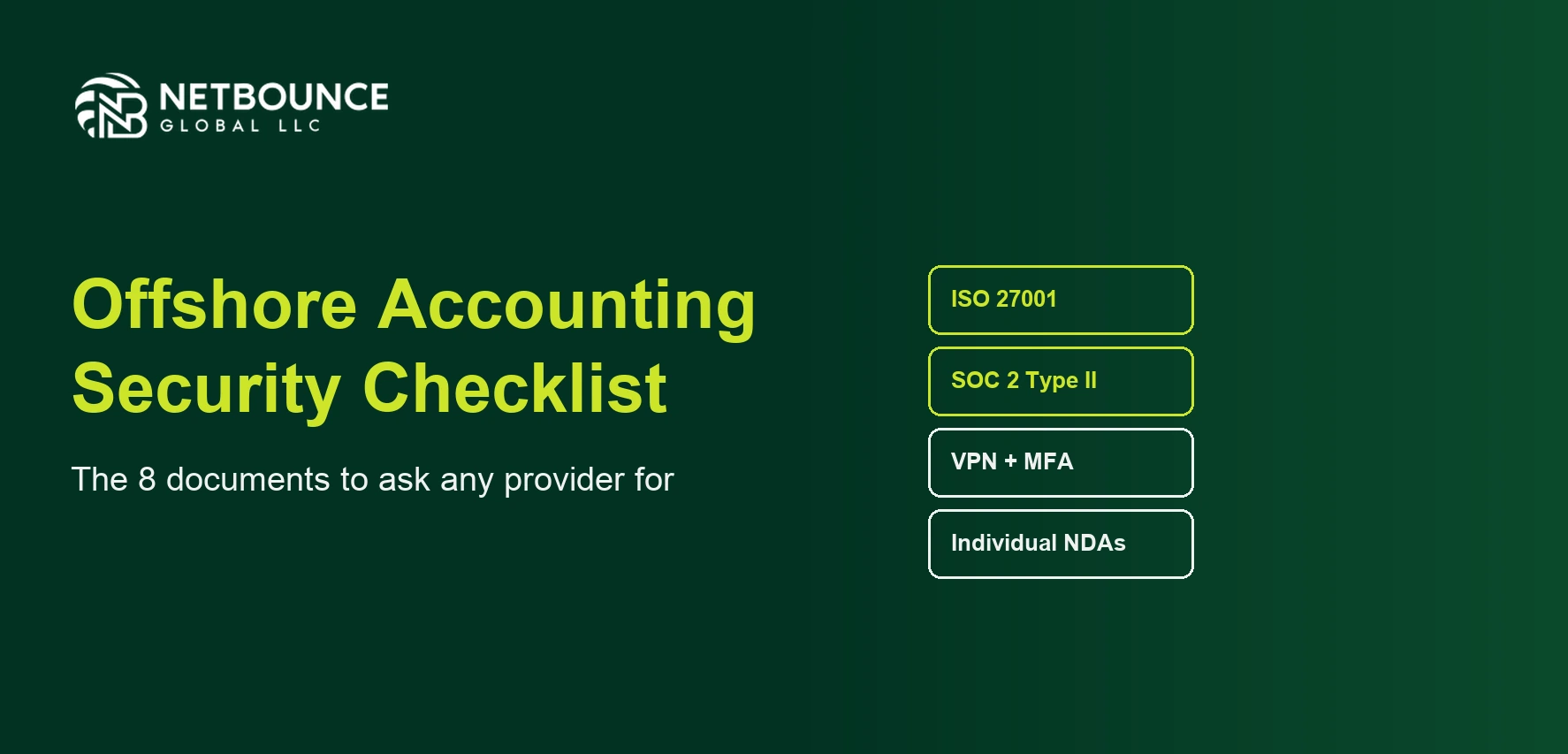
Call it the Offshore Data Security Checklist: eight documents a provider should be able to produce on request, covering people, systems, and contracts together. If a provider can walk through these calmly, with paperwork rather than reassurance, the security conversation is largely done.
The checklist is not a formality. It is the difference between a provider who built security into how they operate and one who added a page to their website after a prospect asked.
| Control | What to ask for | Red-flag answer |
|---|---|---|
| ISO 27001 certificate and scope | The certificate itself, plus the scope statement showing which locations and processes it covers | “We’re ISO certified,” with no document produced |
| SOC 2 report type | A Type II report, which tests controls over a period, not just Type I, which only tests design on paper | A Type I report presented as if it were equivalent |
| VPN-restricted access | Confirmation that staff reach client systems only through a controlled, logged VPN connection | “Our team can log in from anywhere they’re working” |
| Multi-factor authentication | MFA enforced on every account that touches client data, not just admin logins | Password-only access, or MFA described as optional |
| No local file storage | A written policy stating client files never save to a local device or personal drive | Silence, or “we haven’t had a problem with that” |
| Individual NDAs | A signed NDA per staff member assigned to your account, not one company-level agreement | “Our company already has an NDA with you” |
| Background checks | Confirmation that checks run before placement, with a record you can review | No documented process, or checks run only after a problem |
| Offboarding of access | A defined step that revokes system access the same day someone leaves or rotates off your account | “We’ll take care of that when it happens” |
Run a simple threshold test: if a provider cannot produce documentation for at least three of these eight items, stop the conversation. A provider who is genuinely built for this work will have most of the list ready before you ask, not after.
ISO 27001 vs SOC 2: What Each Proves
These two certifications get used almost interchangeably in sales conversations, and they prove different things. Confusing them is one of the most common ways a firm ends up with less assurance than it thinks it has.
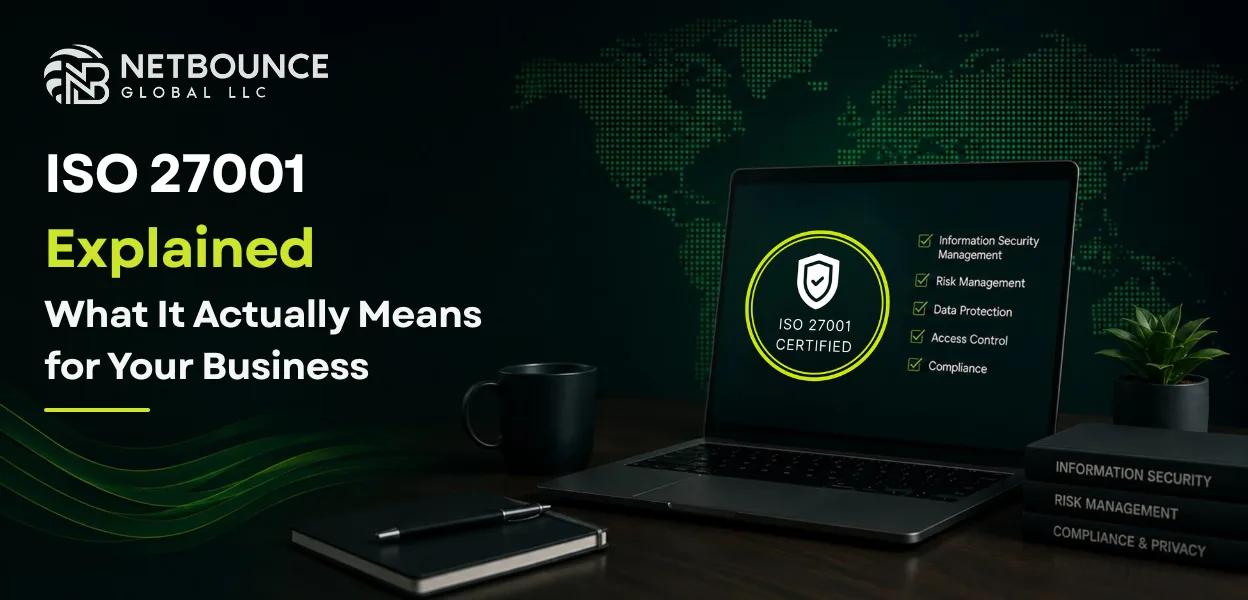
ISO 27001 certifies that an organization runs a formal information security management system: documented policies, risk assessments, and regular internal audits, verified by an accredited external auditor. It answers “does this provider have a security program at all?”
SOC 2 is a report, not a certification, built around specific trust service criteria such as security, availability, and confidentiality. A Type II report tests whether the provider’s controls actually operated as described over a period, usually six to twelve months. It answers “did the stated controls hold up in practice?”
Here is the gap that catches firms off guard: a certificate can cover a provider’s headquarters without covering the delivery center where your work actually gets done. Always check the scope statement, not just the certificate’s existence. NetBounce Global, for instance, can point to one scope that covers the entities actually placed on client work. That is the detail worth confirming with any provider you evaluate.
Ask for both when you can get them. ISO 27001 shows the program exists. SOC 2 Type II shows it worked.
“Our Data Can’t Leave the US” and Other Objections
Some firms respond to any offshore conversation with a flat rule: client data cannot leave the United States. The instinct is reasonable. The rule, as usually stated, misunderstands how modern offshore security actually works.
Properly configured offshore staffing uses access models, not transfer models. Staff log into your systems, your software, and your file storage from another location. The data itself does not move to a foreign server. The person works inside infrastructure that stays where you put it, through a controlled connection. That distinction, access versus transfer, is the one worth asking any provider to walk you through directly.
This matters because your compliance obligations do not disappear just because the work is offshore. IRS Publication 4557 covers safeguarding taxpayer data. The FTC Safeguards Rule, under the Gramm-Leach-Bliley Act, covers the same ground from a different angle. Both apply regardless of where your staff sit. The question is not whether offshore work is allowed. It is whether your provider’s setup lets you stay compliant with the rules you already follow.
NBG places staff on exactly this access model: dedicated people working inside your existing systems, never a transfer of your data to infrastructure you do not control.
Where Offshore Setups Still Fail
An honest checklist has to name where this model breaks down, because it does, under specific conditions.
Shared staff across multiple clients is the most common failure. When one offshore worker splits time across five client accounts, access boundaries blur and accountability gets harder to trace if something goes wrong. Turnover compounds it: a staff member who leaves without a clean offboarding step can leave access open for weeks.
Time zone gaps create a second kind of risk. If an incident happens at 2 a.m. your time and the provider’s security team does not start its day until your evening, the response window stretches longer than it should.
There is also a management cost that does not show up in the sales pitch. Someone on your side still has to own the vendor relationship. They review the documentation and ask the follow-up questions when something looks off.
Some firms have very small volumes. Others sign client contracts that explicitly restrict where work can be performed. For them, keeping the work in-house may genuinely be the better call. Offshore accounting security solves a real problem. It does not solve every firm’s problem.
How to Run the Checklist Before You Hire an Offshore Accountant
Once you have decided offshore staffing is worth evaluating, run the check in order, not all at once.
- Request the documents first. Ask for the ISO 27001 certificate and scope, the SOC 2 report, and the NDA template before you schedule a call. A provider’s response time here tells you as much as the paperwork does.
- Hold a dedicated security call. Not a sales call that touches on security. A call where your compliance lead can ask exactly where client data physically lives, and expects a specific answer, not a reference to “cloud infrastructure.”
- Review the contract for accountability. Confirm who is liable for a breach, what the notification timeline looks like, and whether access gets revoked automatically when a staff member rotates off.
- Pilot with redacted data. Before any live client file moves, run a trial using redacted or sample data to confirm the access model works the way it was described.
When you hire an offshore accountant through NBG, that documentation is already in place. ISO 27001:2022 certification, VPN-restricted access, and MFA on every account. Individual NDAs per staff member and no local file storage. Dedicated staff who are never shared or rotated across other clients.
You can review the specifics on our data security page. See how the roles are structured on the tax preparer, bookkeeper, and accounting manager pages.
The Real Risk Isn’t Offshore
The real risk in offshore accounting was never the border. It is hiring a provider you cannot verify. A provider who can produce certificates, show you the scope behind them, and put liability in writing has already done the hard part of the work for you.
That is the part we handle. NetBounce Global vets every placement against documented security controls and backs it with a contract that holds up. The only thing left for you to check is the paperwork, not the risk.
Where NBG Stands on This Checklist
We built NetBounce Global around the idea that security should survive a cross-examination, not just a sales call. Founded in 2023 and registered in Austin, Texas, with operations based in India, we hold certifications covering the entities that actually deliver client work, not just a headquarters address.
Why firms work with us:
- Backed by certification, not claims. ISO 27001:2022 certified and covered by a SOC 2 Type II report, GDPR compliant, with zero data breaches across NBG’s history.
- Access locked down by design. VPN-only access, MFA enforced on every system, and no local data storage, ever.
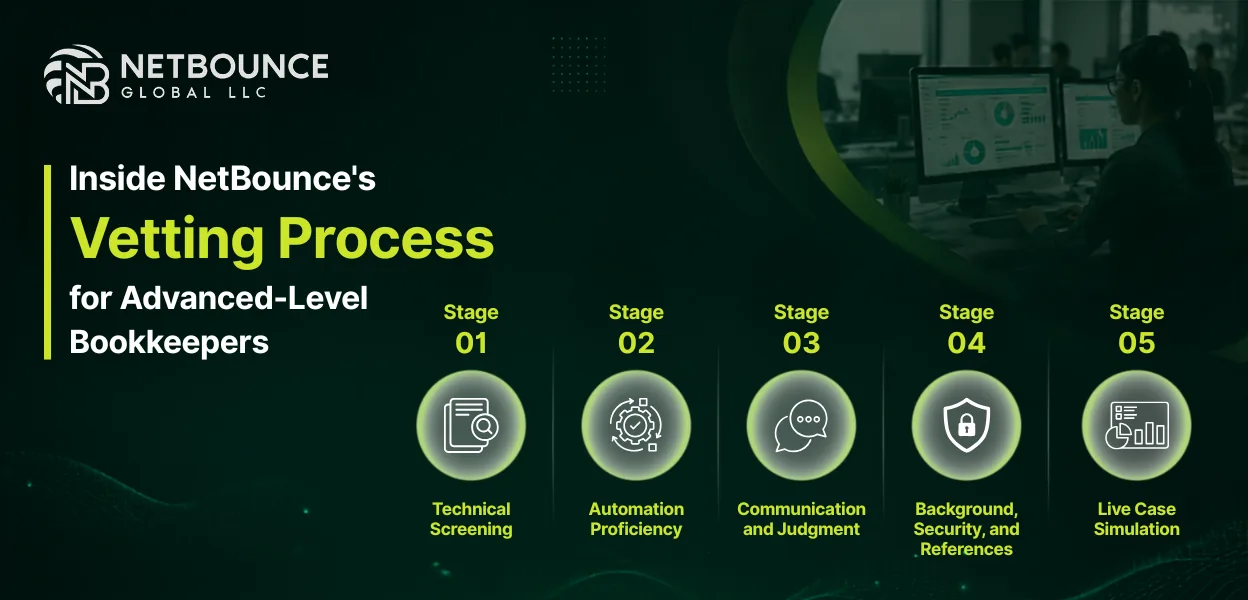
- Vetted before you ever see a resume. Every placement runs through a 7-parameter vetting process, with an individual NDA signed by each staff member assigned to your account, not one blanket company agreement.
- Dedicated, not shared. Staff work for your firm alone. Nobody is rotated across other clients or split between accounts.
Speed matters too. We can produce vetted profiles within 48 hours of a request, place a candidate in about 4 days, and back every placement with a 4-day contractual replacement SLA if the fit is not right. Payroll, HR, and compliance for your offshore staff are managed entirely on our end, so the only thing left on yours is the work itself.
A zero-breach record does not happen by accident. It comes from treating every control on the checklist above as non-negotiable, for every client, every time, not just the ones who ask.
That is not a sales pitch. It is the checklist above, answered line by line, before you ever have to ask.
Frequently Asked Questions
Yes, when the provider can show certification, access controls, and contractual accountability you can verify directly. Offshore accounting security rests on documented controls across three layers: people, systems, and contracts. A provider with ISO 27001 certification, a current SOC 2 Type II report, individual NDAs, and a clear liability clause has met the bar that matters. The risk in offshore accounting has never been geography. It’s working with a provider who can’t produce documentation to back up what the sales deck claims.
Look for ISO 27001 certification with a scope statement that covers the actual delivery location doing your work, not just the provider’s headquarters. A SOC 2 Type II report adds a second layer of assurance, since it tests whether stated controls held up over time rather than just existing on paper. Together, these two show both that a security program exists and that it functions in practice, which is the combination worth asking for before any contract gets signed.
Not under a properly built access model. Staff log into your existing systems and software from their location; the data itself stays on infrastructure you control rather than transferring to a foreign server. Ask any provider to walk you through exactly how their staff connect, and confirm it’s access, not transfer, before you move forward. Your obligations under IRS Publication 4557 and the FTC Safeguards Rule still apply either way, so the setup needs to support compliance, not work around it.
Treat it as a stop signal rather than a minor gap. The checklist covers eight items: ISO 27001 scope, SOC 2 report, VPN access, MFA, no local storage, individual NDAs, background checks, and offboarding steps. If a provider can’t produce documentation for at least three of them, that’s a sign the security program is informal or incomplete. A provider genuinely built for this work keeps this documentation ready before a prospect even asks for it.
Offshore accounting is accounting work performed by staff based outside the United States. In a staffing model the person works inside your firm’s own systems, follows your procedures, and reports to your reviewer, so what moves offshore is the labour rather than the client relationship or the data. It covers the same work a local hire would do, from bookkeeping and reconciliations through month-end close, financial statements, and tax preparation, depending on the role. The distinction that matters for security is access versus transfer: a properly built offshore setup gives staff controlled access to systems you already control, rather than copying client files to infrastructure in another country.